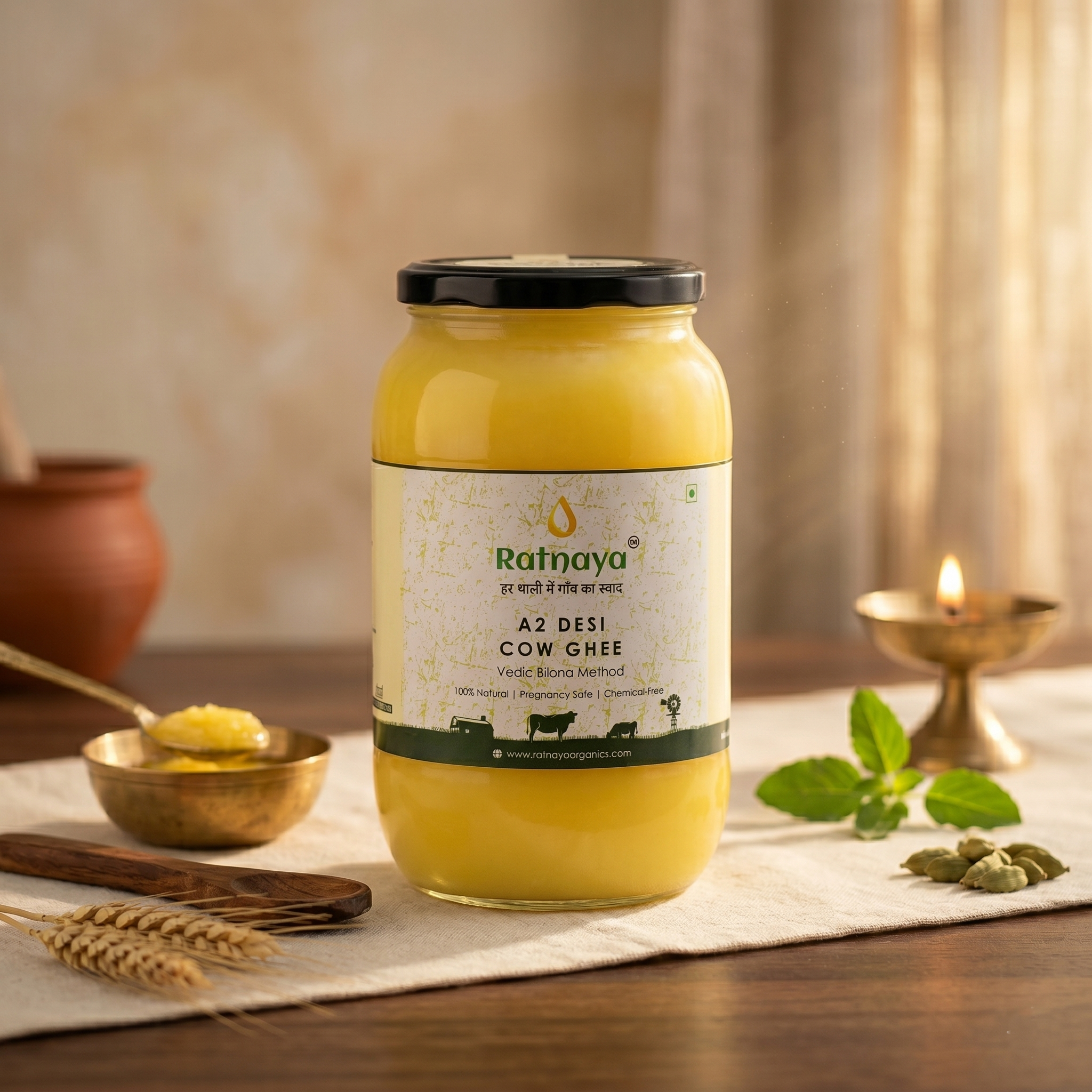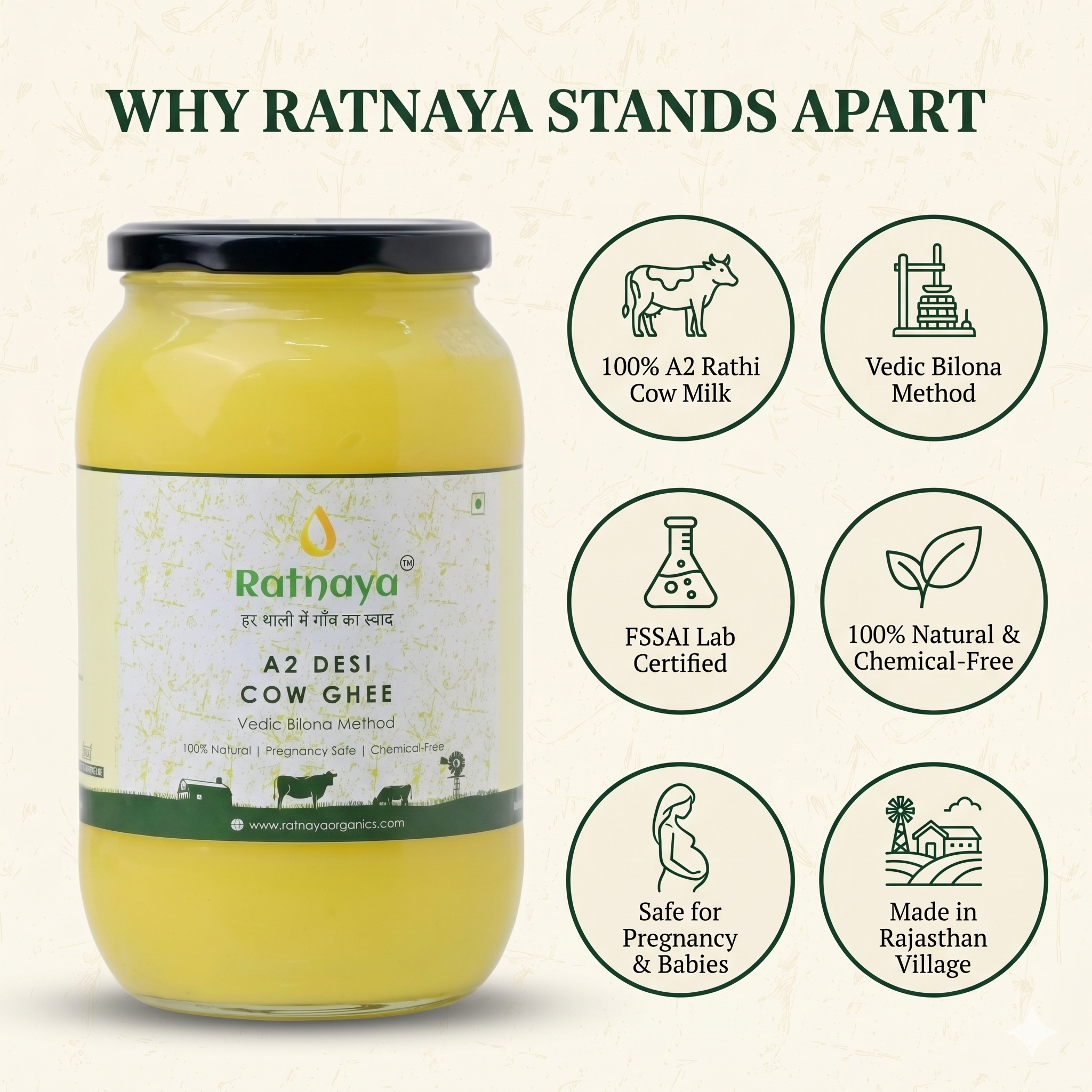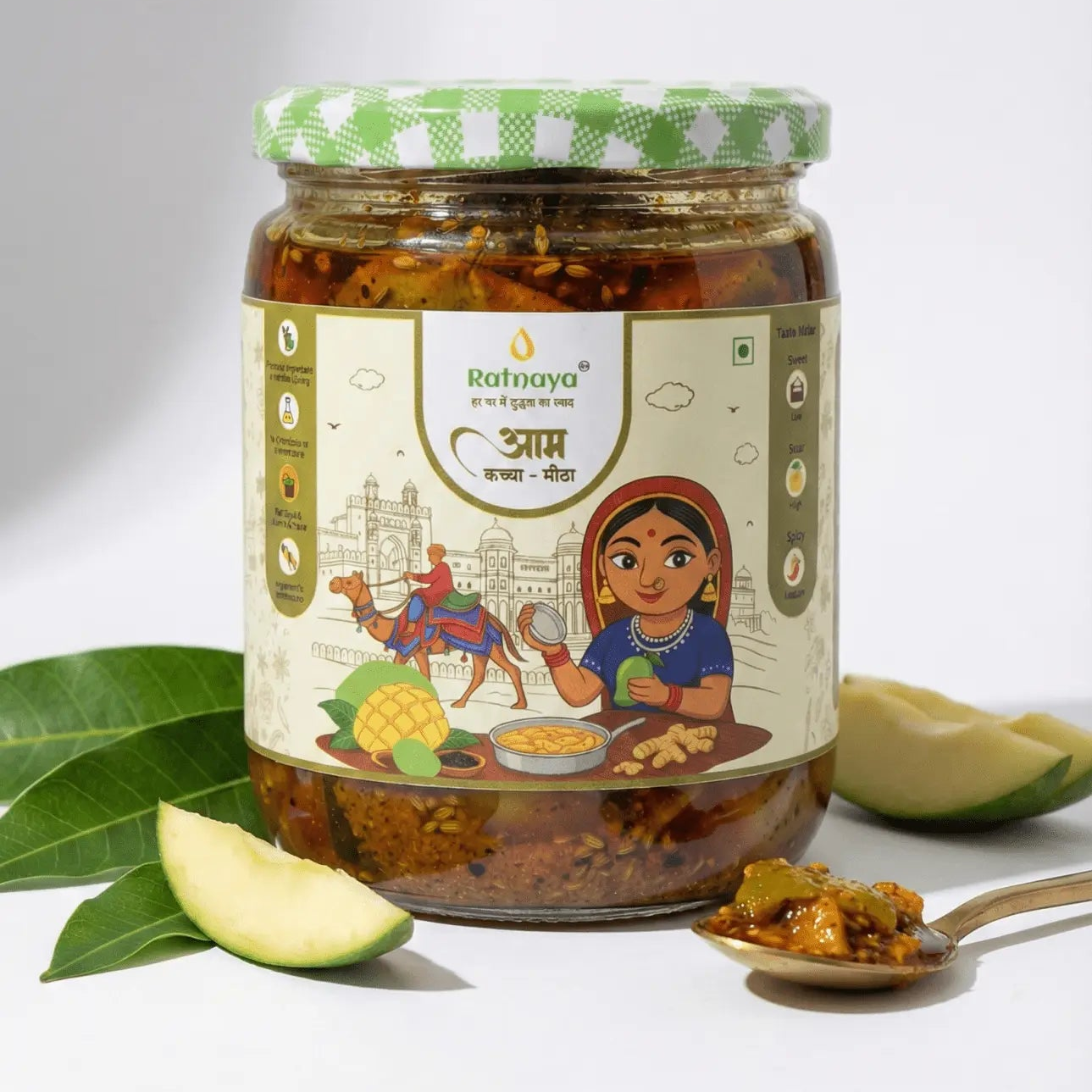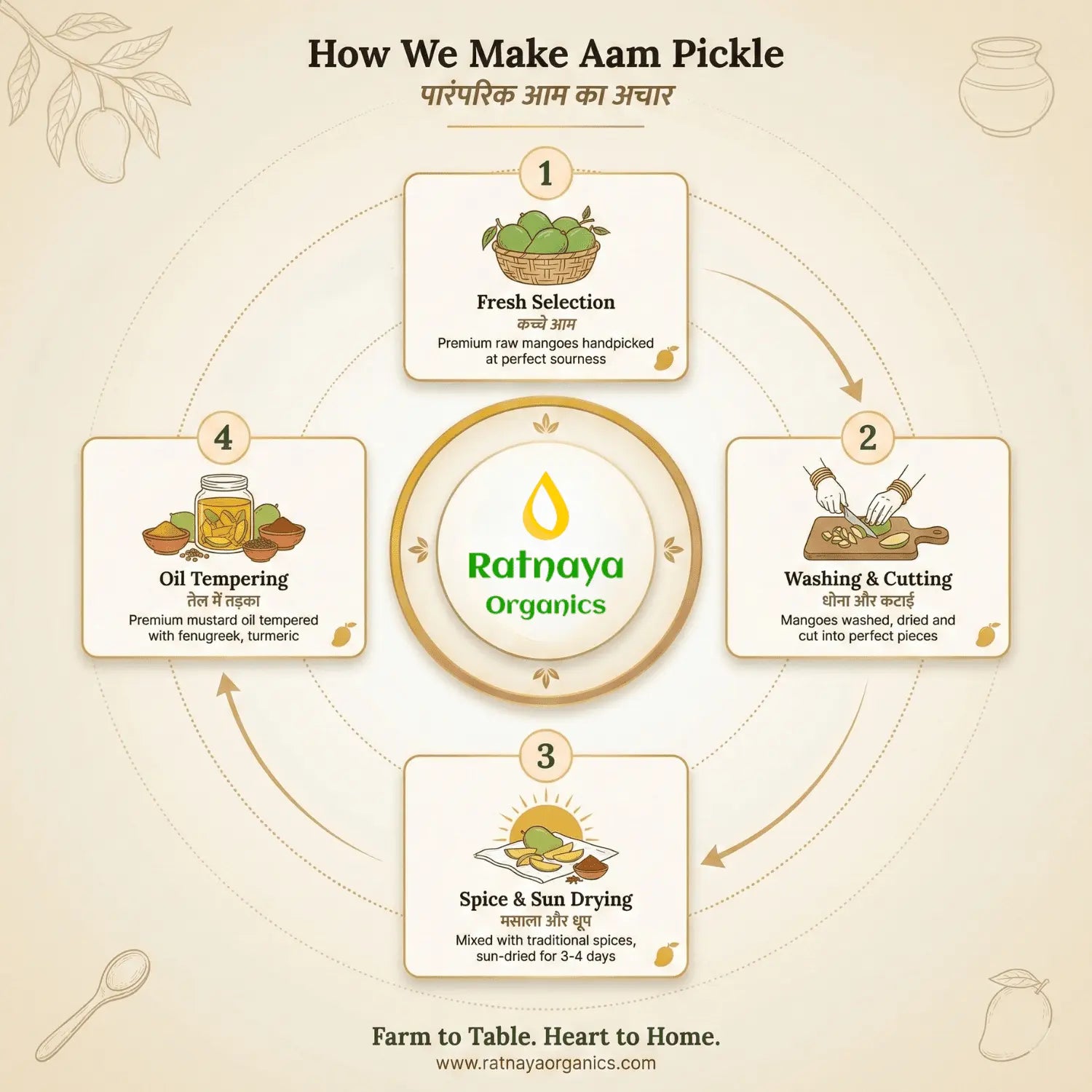

Last week, a customer sent me a WhatsApp message that made me both angry and sad. She’d bought “A2 ghee” from a popular online seller at ₹900 per kilogram - seemed like a good deal. But when she did the simple palm test we’d discussed, the ghee barely melted. When she refrigerated it, distinct layers formed. She’d been feeding her six-month-old baby this fake ghee for two months.
I’m Arvind from Ratnaya Organics, and stories like this remind me why educating consumers about ghee quality matters so much. The market is flooded with products claiming to be “pure A2 ghee,” but most are either adulterated or not A2 at all. Today, I want to share everything I know about identifying genuine A2 ghee - from simple home tests to understanding lab certifications.
The Reality of Ghee Adulteration in India
Let me be blunt - ghee adulteration is a massive problem. FSSAI raids across India regularly uncover thousands of kilograms of fake ghee. In Gujarat’s Palanpur district alone, authorities seized over 2,700 liters of suspected spurious ghee in April 2024. During Rajasthan’s festive season, 3,100 kg of adulterated ghee was confiscated in Barmer.
The Food Safety and Standards Authority of India has developed new testing methods specifically to detect ghee adulteration with vegetable oils, because the problem has become so widespread. These new methods detect even minute presence of adulterants like soybean oil, groundnut oil, coconut oil, and sunflower oil by measuring β-sitosterol markers.
Why is adulteration so common? Simple economics. Authentic A2 ghee costs ₹1,800-2,500 per kilogram to produce. Mixing in vanaspati (hydrogenated vegetable oil) at ₹120/kg or palm oil at ₹150/kg dramatically cuts costs while making it nearly impossible for average consumers to tell the difference.
Understanding What “A2” Actually Means
Here’s where most confusion starts - what does “A2” actually mean, and how do you verify it?
A2 refers to a specific type of beta-casein protein found in milk. According to research on A2 milk, the distinction between A1 and A2 beta-casein differs by just one amino acid, but this single difference significantly affects how the milk is digested. Indigenous Indian cow breeds like Gir, Sahiwal, Rathi, and Red Sindhi naturally produce only A2 beta-casein. Crossbred and foreign breeds like Holstein and Jersey typically produce A1 or a mix of A1 and A2.
The critical thing to understand - you cannot test ghee itself to confirm it’s A2. The protein structure changes during ghee-making when butter is heated and clarified. The only way to genuinely verify A2 ghee is through the source cow’s genetics or the raw milk before processing.
A2 Certification and Testing Reality
This might surprise you, but FSSAI doesn’t officially recognize “A2 milk” as a standardized product category. In fact, recent FSSAI guidelines instructed food business operators to remove A1/A2 protein claims from labels on milk fat products because these claims are “misleading and not in conformance” with regulations. The reasoning? A2 differentiation relates to protein structure, and ghee is essentially pure milk fat with proteins removed during clarification.
So when sellers claim “certified A2 ghee,” what does that certification actually mean? Legitimate A2 verification comes through:
Genetic Testing of Cows: The most accurate method involves DNA testing of individual cows through blood samples, hair follicles, or milk. Labs use PCR (Polymerase Chain Reaction) technology to identify whether a cow has A2A2 genetics. This test costs around ₹4,000 per cow.
Milk Protein Analysis: Before ghee-making, milk can be tested for A2 beta-casein presence using ELISA assays or LC-MS/MS methods. However, this only confirms the source milk quality, not the finished ghee.
The reality? Most small producers (like us) don’t have individual DNA tests for every cow. Instead, we rely on breed purity - our Rathi cows are indigenous Indian cattle that naturally produce A2 milk. The trust comes from transparency about breed, farming practices, and willingness to discuss our methods openly.
Simple Home Tests for Ghee Purity
While you can’t easily test for A2 protein at home, you can definitely test for common adulteration. Here are methods I recommend every buyer should know:
The Palm Test: This is my favorite because it’s so simple. Put a small amount of ghee on your palm and wait. Pure ghee melts almost instantly at body temperature (37°C). If it stays solid or takes several minutes to melt, it’s likely mixed with vanaspati or hydrogenated fats that have higher melting points. I do this test with every new batch we make - it should melt in 10-15 seconds on your palm.
The Refrigeration Test: Put a small bowl of ghee in your refrigerator for 30 minutes, then observe carefully. Pure ghee solidifies uniformly with a grainy, crystalline texture. Adulterated ghee often forms distinct layers - you’ll see oil separation or uneven solidification. This happens because different fats have different solidification temperatures. If you see any layering, don’t consume that ghee.
The Heat Test: Heat one teaspoon of ghee in a pan on low flame. Pure ghee melts quickly, turns deep golden-brown, and releases a rich, nutty aroma. It should be completely liquid with no residue. Adulterated ghee takes longer to melt, may turn yellowish instead of golden-brown, and often leaves sticky residue or forms a foam layer on top.
The Iodine Test: This detects starch adulteration. Add 2-3 drops of iodine tincture to a teaspoon of melted ghee. Pure ghee shows no color change. If the mixture turns blue or purple, starch has been added (sellers add starch to increase volume and thickness). Multiple consumer guides on testing ghee purity at home recommend this as one of the most reliable simple tests for detecting one of the most common adulterants.
The Water Test: Drop a spoonful of ghee into a glass of warm water. Pure ghee floats cleanly on top and eventually forms a single blob. Adulterated ghee may dissolve, sink partially, create cloudiness, or leave residue at the bottom.
The HCl Test: This is harder to do at home since it requires hydrochloric acid, but it’s very effective. Heat a tablespoon of ghee, add equal amount of concentrated HCl and a pinch of sugar, then shake well. Wait 5 minutes. Pure ghee shows no color change. If the bottom layer turns pink or red, the ghee is adulterated with vanaspati (this detects the sesame oil that’s mandatory in vanaspati by Indian law).
I’ve demonstrated these tests in videos on our Instagram, and it’s amazing how many people discover they’ve been buying fake ghee for years.
Visual and Sensory Clues
Beyond formal tests, your senses are powerful tools. Here’s what I’ve learned from making thousands of kilograms of ghee:
Color: Authentic bilona A2 ghee has a deep golden-yellow color - think of turmeric mixed with sunlight. The exact shade varies slightly with cow’s diet (grass-fed cows produce deeper colored ghee) and season. Winter ghee tends to be darker. Commercial ghee is often pale yellow or even whitish. Artificial color additives might make ghee unnaturally bright or orange-tinted.
Texture: Pure ghee has a grainy, crystalline texture when solidified, especially if made traditionally. When you scoop it with a spoon, it should have body without being waxy. At room temperature (around 25°C), it should be semi-solid - not rock-hard, not completely liquid. In summer, it loosens; in winter, it solidifies more. This natural response to temperature is a good sign.
Aroma: This is where experience matters. Authentic bilona ghee has a rich, slightly caramelized, nutty aroma that’s unmistakable. It shouldn’t smell rancid, artificially sweet, or have a bland industrial smell. When you heat pure ghee, the aroma intensifies beautifully - it should make your mouth water. If heating produces a burnt or chemical smell, that’s a red flag.
Taste: Pure ghee has a complex flavor - slightly sweet, nutty, with a smooth mouthfeel. It should melt on your tongue without leaving a greasy coating. Adulterated or poor-quality ghee often tastes flat, overly greasy, or leaves an unpleasant aftertaste.
Understanding Lab Testing and Certifications
For buyers who want more certainty, understanding lab testing helps evaluate seller claims:
FSSAI License: This is mandatory, not optional. Every ghee seller must have a valid FSSAI license number displayed on packaging. You can verify the license on FSSAI’s website. However, an FSSAI license only means the facility is registered - it doesn’t guarantee quality or authenticity.
Fat Content Analysis: Pure ghee should contain minimum 99.5% milk fat according to FSSAI standards. Maximum moisture content is 0.5%. Legitimate sellers provide lab reports showing these parameters.
Fatty Acid Profile: Advanced testing like gas chromatography can identify the specific fatty acid composition. Pure cow ghee has characteristic ratios of saturated and unsaturated fats that differ from vegetable oils or buffalo ghee. This is expensive but definitive.
Refractive Index (BR Reading): The Butyro-Refractometer reading measures the purity of fats. Pure ghee has a specific refractive index range. Adulteration with cheaper oils changes this reading.
Cholesterol and β-Sitosterol Testing: This is the method FSSAI recommends for detecting vegetable oil adulteration. Comprehensive ghee testing guides from environmental laboratories explain that pure ghee contains cholesterol but no β-sitosterol (a plant sterol). Presence of β-sitosterol indicates plant-based oil mixing, using advanced techniques like FTIR spectroscopy and gas chromatography to separate and identify specific fatty acid markers.
Honest sellers will share lab reports. When we test our ghee, I post the reports on Instagram and share them with customers who ask. If a seller refuses to provide testing documentation, consider that a warning sign.
Questions to Ask Any A2 Ghee Seller
Here are the specific questions I recommend asking before buying:
1. What specific breed of cow produces your milk? Vague answers like “desi cows” or “Indian cows” aren’t enough. Ask for specific breeds - Gir, Sahiwal, Rathi, Red Sindhi, etc.
2. Do you own the cows or source milk from farmers? Ownership models matter. Own-farm operations have more control over quality. If sourcing from farmers, ask about their quality verification process.
3. Can you show me DNA test reports for your cows? Even if they don’t test every cow, serious A2 producers test at least some animals to verify breed purity.
4. What’s your production method - bilona or commercial? If they claim bilona, ask them to describe the process in detail. Vague or scripted answers suggest they’re just using marketing terms.
5. How many liters of milk do you use per kilogram of ghee? The answer should be 25-30 liters. If they say 15-20 liters, they’re likely using cream separation instead of full milk curd method.
6. What’s your milk yield per cow per day? Indigenous cows give 6-12 liters/day. If they claim 20+ liters from “desi cows,” those are probably crossbred.
7. Can you provide recent lab testing reports? Ask for fat content, moisture content, and ideally fatty acid profile or adulteration tests.
8. What’s your refund policy? Confident sellers offer money-back guarantees. We tell customers - if you’re not satisfied with quality after trying our ghee, we’ll refund you. No questions asked.
9. Can I visit your farm or production facility? This isn’t always practical, but willingness to show their operation speaks volumes about transparency.
Legitimate producers will answer these confidently and provide documentation. Evasive or defensive responses are red flags.
The Trust Factor in A2 Ghee
Here’s an uncomfortable truth I’ve realized - in the current regulatory environment, buying A2 ghee requires some level of trust in your producer. Since FSSAI doesn’t recognize A2 claims on ghee and genetic testing is expensive and impractical for finished products, complete scientific verification isn’t accessible to most consumers.
This is why I emphasize building relationships with your ghee supplier. In traditional Indian markets, people bought from the same dairy farmer for decades. They knew the farmer’s cows, saw the farming practices, understood the family’s reputation. Modern e-commerce has broken this connection.
The solution? Look for producers who: - Are transparent about their entire process - Show their farm and cows on social media - Engage directly with customers (not through customer service teams) - Provide detailed answers to questions - Share both successes and challenges honestly - Welcome farm visits or video calls - Have consistent long-term presence (not just pop-up sellers)
At Ratnaya Organics, I personally respond to messages and calls. Customers can video call to see our cows and production process. I share updates about our challenges - when milk production drops in summer, when a cow falls sick, when we’re out of stock. This transparency builds trust because it’s real, not marketing.
Regional Variations and What They Mean
Something important to understand - authentic A2 ghee varies slightly based on region, season, and specific breed. This variation is natural and actually confirms authenticity:
Seasonal Differences: Winter ghee is typically deeper yellow because cows consume more green fodder. Summer ghee might be slightly paler. The texture is firmer in winter, softer in summer. These variations are signs of genuine, unadulterated ghee responding to natural factors.
Breed Variations: Gir cow ghee tends to be deep golden with prominent granular texture. Sahiwal ghee might be slightly lighter. Rathi cow ghee (what we produce) is medium golden with excellent aroma. These differences exist because each breed has slightly different milk composition. Traditional bilona ghee production methods preserve these natural characteristics, with the slow hand-churning and heating process allowing breed-specific fatty acid profiles and flavor compounds to develop fully.
Diet Impact: Grass-fed cows produce richer colored ghee with more intense flavor compared to grain-fed cows. Organic feed versus conventional feed also creates subtle differences.
If your ghee looks exactly the same bottle after bottle, season after season - that’s actually suspicious. Industrial standardization removes natural variation. Real farm-produced ghee shows natural seasonal shifts.
The Price-Quality-Authenticity Triangle
Let me connect this back to pricing from my previous article. Understanding quality verification helps you see why fair pricing matters:
Authentic A2 ghee from indigenous cows made using bilona method realistically costs ₹1,800-2,500/kg. At this price point, producers can afford: - Maintaining indigenous cow herds (lower milk yield, higher care costs) - Traditional processing methods (labor-intensive, time-consuming) - Quality testing and certifications - Proper food-grade packaging - Transparent business practices
When ghee is priced at ₹900-1,200/kg, something has to give. Either it’s not A2, or it’s not bilona method, or corners are being cut on quality, or it’s simply adulterated. The economics don’t support authentic production at ultra-low prices.
Conversely, when ghee is priced above ₹2,800-3,000/kg, you’re likely paying premiums for branding rather than proportionally better quality. The sweet spot for authentic A2 bilona ghee is ₹1,800-2,500/kg from producers who demonstrate transparency and quality.
Building Your Verification Checklist
Here’s the practical checklist I recommend for evaluating any A2 ghee:
Before Purchase: - [ ] Specific breed mentioned (not just “desi cow”) - [ ] Production method clearly explained - [ ] FSSAI license visible and verifiable - [ ] Realistic pricing (₹1,800-2,500/kg range) - [ ] Seller provides lab reports on request - [ ] Clear contact information (phone, location, not just email) - [ ] Active social media showing farm operations - [ ] Customer reviews mention quality specifics (not just generic praise)
After Purchase: - [ ] Palm test - melts quickly on hand - [ ] Refrigeration test - uniform solidification - [ ] Heat test - golden-brown color, nutty aroma - [ ] Visual check - grainy texture, natural color - [ ] Taste test - rich flavor, smooth mouthfeel - [ ] Seasonal consistency - natural variations present
If any purchased ghee fails multiple home tests, don’t hesitate to contact the seller for explanation or refund. Legitimate producers stand behind their quality.
What We Do at Ratnaya Organics
Let me share our specific quality verification process as an example of what transparency looks like:
Source Verification: All our ghee comes from our own Rathi cows. Rathi is an indigenous Rajasthani breed that naturally produces A2 milk. We currently have 12 adult Rathi cows, and we can show you each one.
Production Documentation: We document every batch - which cows’ milk, how many liters used, production date, processing time. Each bottle has a batch number linking to this documentation.
Testing Protocol: Every batch undergoes: - Fat content analysis (should be 99.5%+) - Moisture content check (should be <0.5%) - Visual and sensory evaluation by me personally - Random third-party lab testing quarterly
Customer Verification: We encourage customers to: - Do all home tests with our ghee - Compare with other brands (seriously - we want educated customers) - Contact us with any questions or concerns - Visit our farm in Rajasthan (we’ve hosted 50+ visitors)
Quality Guarantee: If you’re unsatisfied with our ghee quality for any reason, we provide full refund within 30 days. No complicated process - just let us know.
This level of verification might seem excessive, but it’s necessary because we understand the broken trust in the market. Every seller claims purity. We prove it.
The Bigger Picture: Why Verification Matters
Beyond personal health, understanding ghee quality verification matters for several reasons:
Supporting Genuine Producers: When you learn to identify authentic ghee, you naturally start buying from legitimate sources. This supports farmers who are genuinely maintaining indigenous breeds and traditional methods rather than those cutting corners.
Preserving Indigenous Cattle: India’s indigenous cow population has been declining for decades as farmers shift to higher-yield crossbreeds. Every purchase of authentic A2 ghee from indigenous breeds creates economic incentive to preserve these valuable genetic resources.
Food System Transparency: The more consumers demand verification and transparency, the more the entire food system improves. When customers ask tough questions, sellers have to either improve quality or exit the market.
Personal Health: This is obvious but worth stating - consuming adulterated ghee means ingesting trans fats from hydrogenated oils, synthetic additives, and potentially harmful substances. Quality verification protects your family’s health.
When to Be Most Careful
Based on patterns I’ve observed, here are situations requiring extra vigilance:
Festive Season Purchases: Demand spikes during Diwali, Dussehra, and other festivals. This is when most adulteration happens as opportunistic sellers flood the market. Buy from trusted sources or test extra carefully.
Deep Discount Sales: If someone offers 40-50% off on A2 ghee, ask yourself - how is that economically viable? Massive discounts on a product with high fixed costs usually signal quality compromise.
New Online Sellers: Be cautious with sellers who have recently started (less than 1-2 years in business) and have limited customer reviews. Established reputation matters in ghee business.
Vague Product Descriptions: If the product listing is full of marketing jargon but light on specific details (breed, method, testing), treat with suspicion.
No Contact Information: Legitimate businesses provide clear ways to reach them - phone numbers, physical address, responsive customer service. Sellers hiding behind generic contact forms are questionable.
Final Thoughts: Informed Buying is Empowered Buying
The reality is this - in today’s market, you cannot blindly trust any ghee label that says “pure A2.” The lack of standardization, combined with rampant adulteration, means consumers must become their own quality inspectors.
But this isn’t as negative as it sounds. Once you understand what to look for - from simple home tests to asking the right questions - identifying genuine A2 ghee becomes straightforward. And the relationship you build with a trusted producer adds value beyond just the product. You’re connecting back to traditional food systems, supporting sustainable farming, and taking control of your family’s nutrition.
At Ratnaya Organics, our goal isn’t just selling ghee - it’s educating customers about quality so they make better choices whether they buy from us or anyone else. An informed customer is our best customer, even if they initially buy elsewhere to compare.
If you’re new to A2 ghee or switching from your current brand, start small. Buy 500g, do all the home tests, observe the quality, and judge for yourself. Don’t take anyone’s word - verify through your own experience.
For those interested in our Rathi cow A2 ghee, we’re at ratnayaorganics.com or reach out on WhatsApp at +91-9001924784. Follow our Instagram @ratnaya_organics to see daily farm operations and get updates on fresh batches.
Remember - the right ghee isn’t just about taste. It’s about trust, transparency, and the traditional values that make food meaningful. Choose wisely.
Frequently Asked Questions About Identifying Pure A2 Ghee
Can I test if ghee is truly A2 at home?
Unfortunately, no. A2 refers to a specific protein structure in milk that changes during the ghee-making process when proteins are removed through clarification. The only accurate way to verify A2 status is through genetic testing of source cows via DNA analysis from blood or hair samples, or through protein testing of raw milk before ghee production. At home, you can verify ghee purity and detect common adulterants through palm tests, refrigeration tests, and heating tests, but these don’t confirm A2 protein specifically. This is why buying from transparent producers who willingly share their cow breeding, genetics, and farming practices is crucial. Indigenous Indian breeds like Gir, Sahiwal, and Rathi naturally produce only A2 milk, so verified breed purity is your best indicator.
What does FSSAI certification really tell me about A2 ghee?
An FSSAI license is mandatory for all food businesses in India, but it only confirms that the manufacturer is registered and meets basic food safety standards - it doesn’t verify A2 claims at all. In fact, FSSAI recently issued guidelines stating that A1/A2 differentiation applies to milk proteins, and since ghee is essentially pure milk fat, A2 claims on ghee are technically misleading. That said, FSSAI does set standards for ghee purity - minimum 99.5% milk fat, maximum 0.5% moisture, and no adulterants. Look for sellers who provide FSSAI-compliant lab reports showing these parameters along with tests for common adulterants like β-sitosterol (indicates vegetable oil mixing). The license ensures basic safety compliance, but A2 verification requires trusting the producer’s cow genetics and farming transparency.
How reliable are home tests for detecting ghee adulteration?
Home tests are surprisingly reliable for detecting common adulterants but have limitations. The palm test effectively detects vanaspati or hydrogenated fats because they have higher melting points than pure ghee. The refrigeration test reveals oil separation in multi-fat mixtures. The iodine test accurately detects starch adulteration. However, these tests won’t catch sophisticated adulteration with similar melting-point fats or detect whether milk came from indigenous versus crossbred cows. Think of home tests as a first-line defense - they’ll catch obvious quality issues and blatant adulteration, which accounts for most problematic products in the market. For complete verification, combine home tests with checking seller transparency, asking detailed questions about sourcing and production, and occasionally getting third-party lab testing done if you’re buying in bulk regularly.
Why do some authentic A2 ghee samples look different from each other?
Natural variation in authentic A2 ghee is actually a positive sign of genuine production. Color varies from pale golden to deep yellow depending on the cow’s diet - grass-fed cows produce darker ghee than grain-fed ones. Seasonal changes affect both color and texture: winter ghee tends to be darker and firmer, while summer ghee is lighter and softer. Different indigenous breeds also produce slightly different ghee profiles - Gir cow ghee typically has deeper color and prominent granular texture, while Sahiwal ghee might be lighter. Additionally, the stage of lactation and individual cow health influence minor characteristics. If ghee looks identical bottle after bottle regardless of season or batch, that suggests industrial standardization and processing rather than traditional small-batch production. Embrace natural variation as confirmation of authentic farm production rather than viewing consistency as a quality marker.
What’s the connection between A2 testing costs and ghee pricing?
Individual cow DNA testing for A2 genetics costs approximately ₹4,000 per animal and must be done through specialized labs using PCR technology. For a small herd of 10-15 cows, that’s ₹40,000-60,000 just for genetic verification - a significant cost for small producers. Ongoing milk protein testing adds more expense. These testing costs directly impact final product pricing. Producers selling authentic A2 ghee either absorb these costs or pass them to customers, which partly explains why genuine A2 ghee costs ₹1,800-2,500/kg versus ₹900-1,200 for regular ghee. However, most small traditional producers rely on breed verification rather than individual testing - if cows are pure indigenous breeds like Gir or Rathi from verified lineages, they naturally produce A2 milk. This reduces costs while maintaining authenticity through breed purity rather than expensive per-animal testing, making authentic A2 ghee more accessible.
Should I buy A2 ghee from large brands or small producers?
Both have advantages and trade-offs. Large brands offer consistency, standardized quality control, wide availability, and often have extensive lab testing infrastructure. However, they typically charge premium prices (₹2,500-3,500/kg) that include heavy marketing costs, they source milk from multiple farmers making breed verification difficult, and their industrial processes may not match traditional bilona methods despite claims. Small producers like us offer more transparency since you can often interact directly with the farmer, see actual cows and production methods, get better prices by eliminating middlemen (₹1,800-2,200/kg), and typically use traditional methods authentically. The downside is less consistency, smaller production capacity, and limited availability. My recommendation: prioritize transparency and verification regardless of size - whether large or small, choose sellers who readily share detailed production information, lab reports, and allow farm visits or detailed questions.
About the Author
I’m Arvind, founder of Ratnaya Organics in Rajasthan. After years in engineering, I returned to my roots to start a farm focused on indigenous Rathi cows and traditional A2 ghee production. Every day, I’m hands-on with our cows, the bilona process, and direct customer interactions. My goal is to make authentic A2 ghee accessible while educating consumers about quality verification and supporting sustainable indigenous cattle farming.
Connect with us: - Website: ratnayaorganics.com/
WhatsApp: +91-9001924784
Instagram: @ratnaya_organics
Related reading: we have since published a fuller breakdown of which ghee purity tests actually work and which do not, including the one home test FSSAI endorses and our own NABL-accredited lab report in full — How to Check Ghee Purity: What Actually Works and What Doesn't.