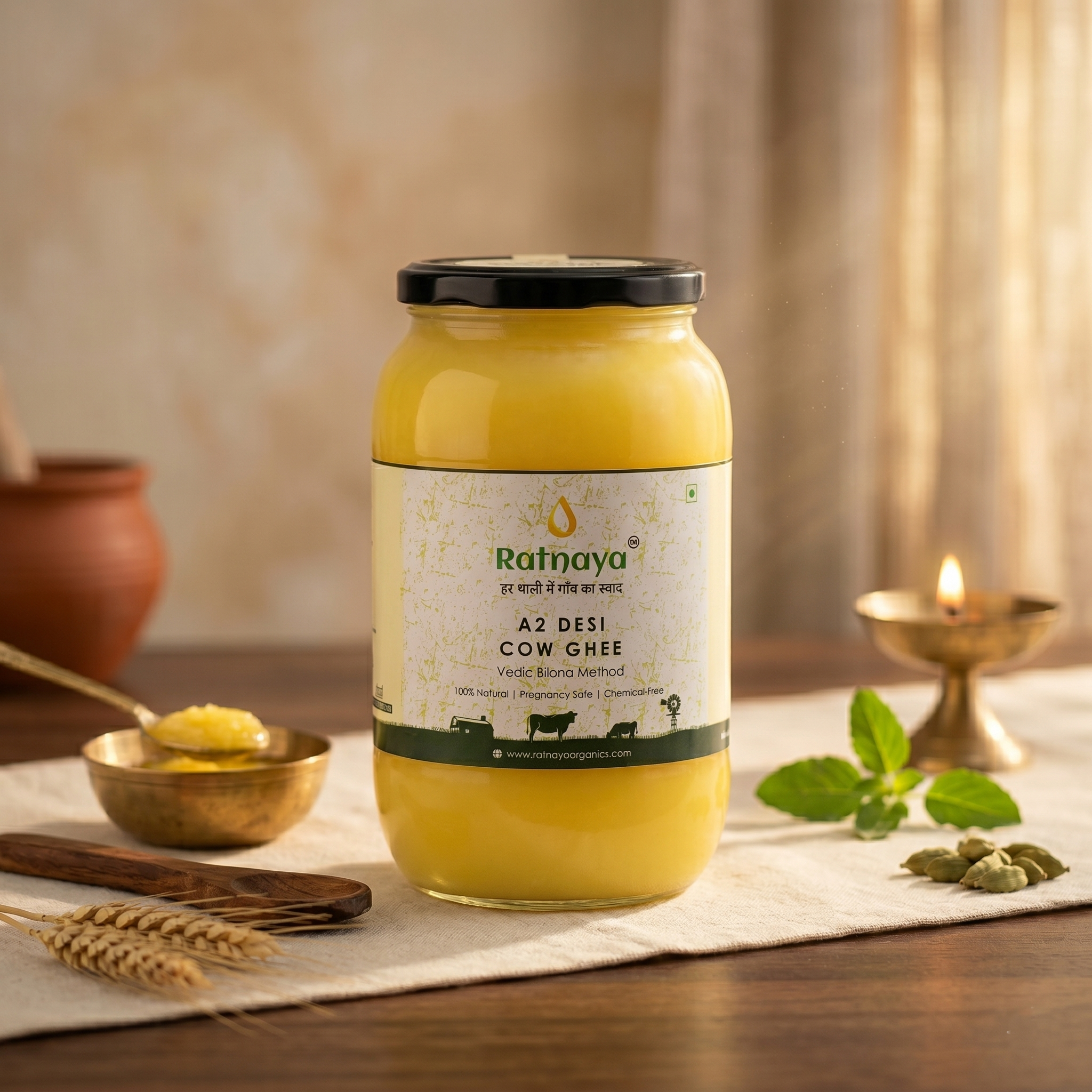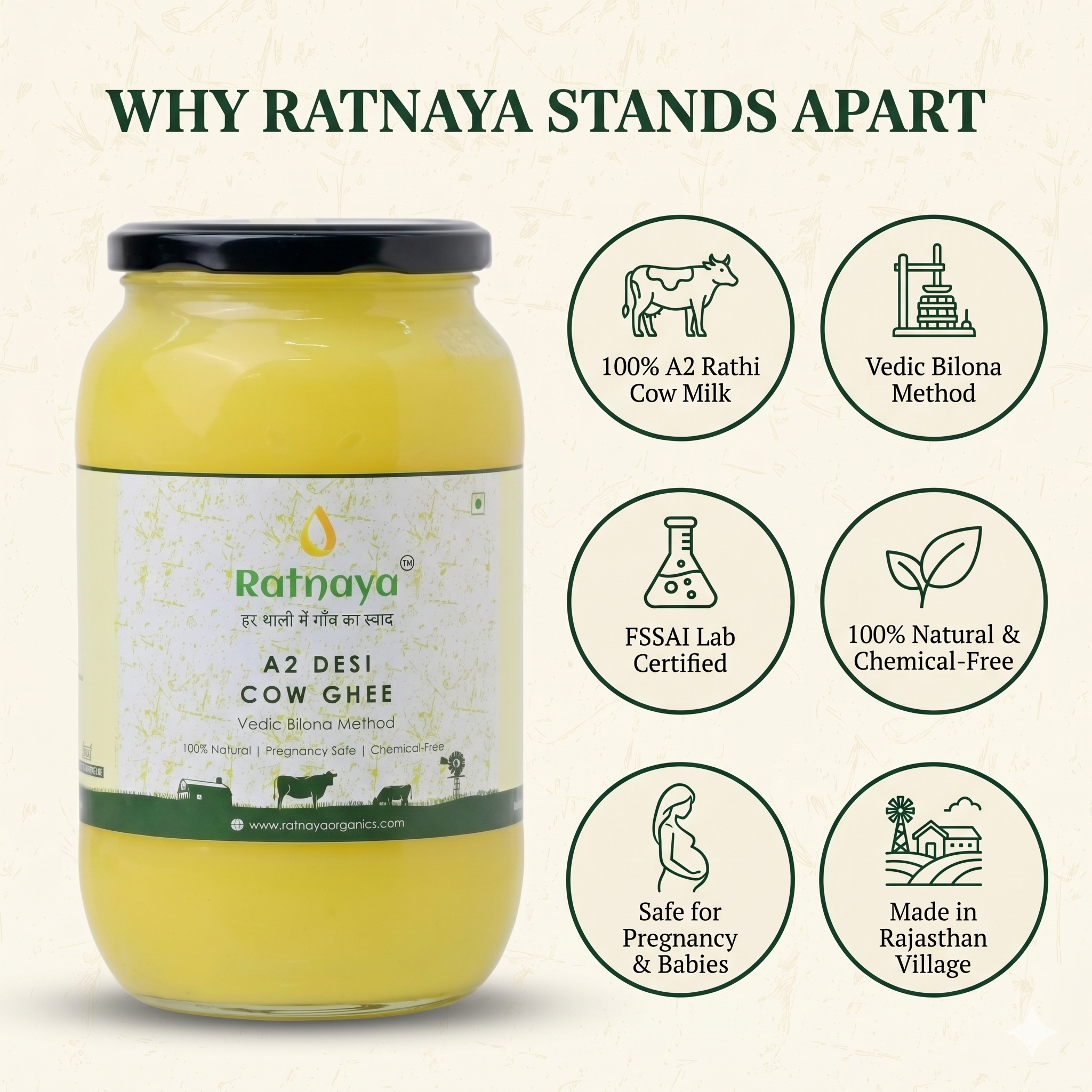

India's A2 ghee market is growing at 22.3% CAGR. Within that wave, a quiet shift is happening: discerning buyers - those who've already moved past supermarket ghee - are now asking a second question. Not just "is it A2?" but "which breed, which farm, which method? & which Ghee" The answer increasingly points to one underdog: the Rathi Cow Ghee. At Ratnaya Organics, we've produced nothing else since 2019. This is everything we know about it.

"Rathi cow ghee" searches grew 340% in 12 months, and supply can barely keep up.
Type "A2 ghee" into any search engine and you'll get 40 million results. Type "Rathi cow ghee" and you'll get a fraction of that. This gap is not because Rathi cow ghee is inferior. It is because the Rathi cow is indigenous to Rajasthan's Thar desert - remote, low-volume, and stubbornly unscalable. You cannot factory-farm a Rathi. You cannot push her milk output with hormones without breaking what makes her special. She gives 6–8 litres per day - on her terms - and every litre is extraordinary.
At Ratnaya Organics, our partner farmer Prem Singh milks 30+ Rathi cows at 5 AM every morning in Shoypura village, Sri Ganganagar. We've been making Rathi cow ghee the bilona way since day one - curd, hand-churn, slow heat. We've never used the cream method. We never will. This guide is our honest account of what the Rathi cow is, why her ghee is different, and how to buy A2 desi ghee online without being misled by clever labels.
"The indigenous breeds of India, especially those native to arid zones like the Rathi, carry genetic adaptations that produce milk of higher nutritional density per litre than high-yielding crossbreeds. Their A2 beta-casein milk is closer in composition to human breast milk than that of any foreign breed."
- National Bureau of Animal Genetic Resources (NBAGR–ICAR), Government of India · Breed Characterisation Studies
What Makes the Rathi Cow India's Most Underrated Heritage Breed?
The Rathi cow - classified as a heritage cow by ICAR and the National Bureau of Animal Genetic Resources - is native to the Bikaner and Ganganagar districts of Rajasthan. She has been bred by the Rath community for over a thousand years as both a draught and dairy animal, specifically adapted to the extreme heat and sparse vegetation of the Thar desert. This adaptation is her superpower.
When an animal evolves to survive in scarcity, its biology becomes efficient in ways that high-yield crossbreds cannot match. The Rathi cow converts low-quality desert fodder into concentrated, nutrient-dense milk. Less volume. More richness. More A2 beta-casein. More beta-carotene (that deep gold colour in pure heritage cow ghee). More omega-3. This is why Rathi cow ghee looks, smells, and tastes different from every other A2 ghee you've tried - and why our customers consistently describe it as "the first ghee that felt like food."
Rathi Cow vs Gir Cow vs Sahiwal Cow - Heritage Breed Comparison
Factor |
🏆 Rathi Cow (Ratnaya’s Pick) |
Gir Cow |
Sahiwal Cow |
|
Native region |
Thar Desert, Rajasthan |
Gir Forest, Gujarat |
Punjab & Haryana plains |
|
Daily milk yield |
6–8 litres |
10–12 litres |
8–15 litres |
|
Milk fat percentage |
4.5–5.8% |
4.0–5.0% |
4.5–5.0% |
|
Beta‑carotene (golden hue) |
Very high (deep yellow ghee) |
High (rich yellow ghee) |
Good (noticeable yellow ghee) |
|
Omega‑3 healthy fats |
Highest |
Good |
Good |
|
A2 protein profile |
Pure A2 |
Pure A2 |
Pure A2 |
|
Climate adaptability |
Extreme desert heat & drought |
Tropical, moderate heat |
Hot‑humid, high rainfall regions |
|
Ghee per litre of milk |
Highest yield (more ghee from less milk) |
Good yield |
Good yield |
|
Digestive comfort |
Very gentle, ideal for sensitive guts |
Gentle, widely accepted |
Gentle, suitable for daily use |
|
Best suited for |
Immunity‑focused families, kids, and elders |
All‑round household and festive use |
Larger households, daily milk use |
|
Market positioning |
Heritage, less commercial, niche premium |
Most marketed A2 breed in India |
Popular in North India, less hyped |
|
Brand highlight |
⭐ Ratnaya’s exclusive Rathi focus |
Often used by big A2 ghee brands |
Trusted by traditional dairy farms |
The Key Rathi Advantage: Concentration over Volume
Because Rathi cows produce less milk per day, their bodies don't dilute nutritional output across large volumes. Every litre is denser in fat, richer in A2 beta-casein, and deeper in beta-carotene than milk from higher-volume breeds. This is why Rathi cow ghee has a deeper gold colour and richer aroma than most A2 ghee on the market - and why it takes even more milk per kg: our bilona process requires 25–30 litres of Rathi milk per kilogram of pure ghee.
How Ratnaya Makes Rathi Cow Ghee - The Traditional Bilona Method
There are two ways to make ghee. One is fast, industrial, and widely used. The other is the bilona method - slow, hand-crafted, and the only way to make ghee that our grandmothers would recognise. We use only the bilona method. Here is what that actually means at our farm:
1) 5 AM - Prem Singh Hand-Milks His Rathi Cows
Every morning before sunrise, our partner farmer Prem Singh (Farmer of the Year 2025) hand-milks his herd of 30+ Rathi cows. Each cow gives 6–8 litres of pure, fresh A2 milk. Forty percent of each day's milk is reserved for the calves - because the calf feeds first, always. No machine milking. No hormones. No stress to the animal. The milk is collected the same morning and sent directly to our processing unit in Shoypura village.
2) Fresh Milk → Overnight Curd (Fermentation)
The fresh Rathi cow milk is gently heated to 40–45°C, a natural curd starter (jaman - from a previous batch) is added, and the milk is left to set overnight at room temperature for 8–10 hours. This fermentation is the step that separates bilona ghee from every commercial product on the market. It dramatically reduces lactose, increases the bioavailability of nutrients, and activates beneficial bacterial compounds that support gut health.
3) Hand-Churning - The Bilona Step
The set curd is placed in a wide clay or wooden vessel. Using a traditional wooden bilona churner - bidirectionally - the curd is churned for 30–45 minutes per batch until makkhan (white butter) separates and floats to the surface. The remaining liquid is pure chaas (buttermilk). This manual step cannot be replicated by a machine without destroying the fat microstructure that makes bilona ghee unique.
4) Slow Heating → Pure Rathi Cow Ghee
The makkhan is transferred to a heavy-bottomed vessel and heated slowly over a low flame - never rushed, never high-heat - for 25–40 minutes, until all moisture evaporates and the milk solids settle golden at the bottom. What remains is pure, aromatic Rathi cow ghee. The colour: deep amber-gold from the Rathi's exceptional beta-carotene. The smell: rich, nutty, faintly caramelised. The texture when cooled: granular, which is the correct mark of authenticity.
5) Straining, Lab Testing & Glass Jar Sealing
The hot ghee is strained through clean muslin cloth, cooled to room temperature, and then poured into food-grade glass jars. Every batch is third-party lab-tested for purity, fat content, and adulteration before dispatch. The jar carries a QR code - scan it to see the source farm, verify certifications, and video-call the farmer. Total farm-to-jar time: 20–24 hours.
Rathi Cow Ghee - The Complete Mind Map

10 Benefits of Rathi Cow A2 Bilona Ghee - What the Science Says
The following benefits apply specifically to A2 Rathi cow ghee made via the bilona method - not generic commercial ghee. The distinction matters because the bilona process preserves nutrients that industrial methods destroy, and the Rathi cow's milk has a different nutritional profile from crossbred dairy cattle.
-
1) Gut Healing (Butyric Acid - 3–4x Higher in Bilona vs Commercial Ghee)
Butyric acid in Rathi cow bilona ghee directly feeds the colonocytes (gut-lining cells), repairs intestinal permeability, and feeds beneficial gut bacteria. 80% of your immune system lives in your gut. This is the most direct path to it - and why it's the ghee that won't cause stomach issues.
2) Children's Immunity - Why Paediatricians in Ayurvedic Practice Recommend It
Vitamins A, D, E, and K in Rathi cow bilona ghee are fat-soluble and require dietary fat to absorb. Ghee provides both. For A2 ghee for kids' immunity: ½–1 teaspoon daily in dal or roti delivers fat-soluble immune nutrients in their most bioavailable form. Our customer, Dr. Anjali Verma (Mumbai), reported her daughter stopped having digestive issues after switching to Ratnaya's Rathi cow ghee.
3) Weight Management via CLA - Not Weight Gain
CLA (conjugated linoleic acid) in grass-fed Rathi cow bilona ghee inhibits fat storage enzymes and supports metabolic rate. MCTs convert directly to energy - not stored fat. A2 ghee for weight loss works when you replace refined vegetable oils with bilona ghee - not add it on top. Start with 1–2 teaspoons per day.
4) Brain Development & Cognitive Function
DHA omega-3 in Rathi cow milk - higher per litre than most breeds - is the primary structural fat in brain tissue. Ayurveda's term for ghee is medhya rasayana: brain tonic. Regular daily consumption supports memory, focus, and mental clarity in both children and adults. Our heritage cow ghee is the same food that sustained the scholars and farmers of Rajasthan for centuries.
5) Skin Glow & Hair Strength - From the Inside
Cow ghee for hair and skin is one of Ayurveda's most-prescribed internal remedies. Fat-soluble vitamins nourish skin cells from within - reducing dryness, reducing pigmentation, and supporting collagen integrity. For hair: Omegaa fatty acids strengthen follicles and reduce breakage. Most customers notice visible changes within 3–4 weeks of daily use.
6) Safe for Lactose-Intolerant People
The bilona method ferments out nearly all lactose during the curd stage. Slow clarification removes remaining casein proteins. Pure Rathi cow ghee is essentially lactose-free - and the A2 protein structure is inherently easier to digest than A1. Most people who identify as A2 ghee for lactose-intolerant users can start with ¼ teaspoon and increase without any dairy reaction.
7) Bone Density & Joint Health
Vitamin K2 in Rathi cow bilona ghee activates osteocalcin - the protein that binds calcium to bone. Ghee also naturally lubricates synovial fluid in joints, reducing morning stiffness and supporting long-term mobility. Especially valuable for seniors, athletes, and anyone with joint discomfort.
8) Heart Health - The Counterintuitive Truth
The saturated fats in Rathi cow bilona ghee are short and medium-chain, associated with raising HDL (good cholesterol) without negatively impacting LDL profiles. Multiple functional medicine and Ayurvedic practitioners now recommend replacing refined vegetable oils with pure cow ghee entirely for better cardiovascular markers.
9) High Smoke Point - Safest Cooking Fat
Pure Rathi cow bilona ghee has a smoke point of 250°C - higher than olive oil, coconut oil, or any refined vegetable oil. At high cooking temperatures, it doesn't oxidise or form carcinogenic compounds. It is the safest traditional fat for Indian cooking styles: tadka, deep-frying, sautéing, and roasting.
10) Morning Ritual Detox
1 teaspoon of warm Rathi cow ghee on an empty stomach - an ancient Ayurvedic practice called Sneha Pana - binds to fat-soluble toxins overnight and carries them out through the digestive tract. It stimulates bile production, supports liver function, and kickstarts Agni (digestive fire) before your first meal. Read our full morning ritual guide →
A2 Ghee Price in India 2026 - What to Pay for Real Rathi Cow Ghee
The single most-searched query in the A2 ghee category after "benefits" is "A2 ghee price". And it's understandable - prices online range from ₹399 to ₹2,800 per kilogram for products all claiming to be "pure A2 bilona." Here's how to read that price range honestly, and what a2 ghee 1kg price should actually look like for a genuine product:

⚠️ The Cost Math - Why ₹600 A2 Bilona Ghee Is Impossible
Authentic Rathi cow A2 milk from an ethical farm: ₹80–100 per litre. Bilona ghee requires 25–30 litres per kg. Raw milk cost alone = ₹2,000–3,000/kg - before 20+ hours of labour, glass jar, lab testing, QR code, and delivery. Anyone selling genuine A2 Rathi cow bilona ghee at ₹600/kg is either using the cream method, A1 cow milk, or both.
Buy A2 Desi Ghee Online - Ratnaya Organics 2026 Pricing

A2 Rathi Cow Ghee vs Every Other Ghee - The Complete Table
|
Factor |
🏆 Rathi Cow A2 Bilona (Ratnaya) |
Gir Cow A2 Cream Method |
Commercial A1 Ghee |
Supermarket Desi Ghee |
|
Cow Breed |
Rathi - Rajasthan heritage |
Gir - Gujarat |
HF / Jersey crossbred |
Unknown mix |
|
Protein Type |
Pure A2 beta-casein |
Pure A2 beta-casein |
A1 dominant/mixed |
A1/A2 mixed |
|
Production Method |
✅ Traditional Bilona |
❌ Cream method |
❌ Industrial |
❌ Industrial |
|
Fermentation Step |
✅ Overnight curd |
❌ No |
❌ No |
❌ No |
|
Butyric Acid |
Highest preserved |
Medium |
Very low |
Minimal |
|
Omega-3 / CLA |
Highest (desert-grass diet) |
Good |
Low |
Negligible |
|
Beta-Carotene (colour) |
Deep amber-gold |
Golden |
Pale yellow |
Pale |
|
Lactose Content |
Near-zero (fermented) |
Very low |
Very low |
Very low |
|
For Babies / Kids |
✅ Ideal - no BCM-7 |
✅ Good |
❌ A1 concern |
❌ Not recommended |
|
Texture when cool |
Granular (authentic) |
Varies |
Smooth (processed) |
Smooth |
|
Farm Traceability |
✅ QR → Meet farmer |
Varies by brand |
❌ None |
❌ None |
|
A2 ghee 1kg price |
₹1,799/kg (Ratnaya) |
₹1,400–2,400 |
₹400–700 |
₹300–600 |
How to Know If Your Rathi Cow Ghee Is Pure - 6 Tests at Home
The most searched ghee problem queries in India: "adulteration in ghee, how to check," and "granular texture ghee real or fake." Here are the answers:
✅ Signs of GENUINE Rathi Cow Bilona Ghee
-
Granular texture when stored below 25°C - NOT a defect. It is crystallised bilona-method fat. This is what real looks like.
-
Deep amber-gold colour - Rathi cow's high beta-carotene. Paler ghee = crossbred or A1 cow.
-
Rich, nutty, caramelised aroma - from slow Maillard reaction during heating. Should smell like toasted hazelnuts.
-
Melts unevenly in the palm within seconds - bilona fat crystals melt at different temperature points.
-
Lab certificate available - every batch, on request, for free.
-
Cow breed and farm address on label - if not mentioned, the brand has something to hide.
❌ Red Flags in A2 Ghee Labelling
-
Perfectly smooth uniform texture - machine-processed, not bilona-churned.
-
Pale yellow or whitish colour - low beta-carotene, likely crossbred or A1 cow milk used.
-
"Why does my ghee smell bad?" - Rancid fat means poor storage, low-quality fats, or adulterants.
-
No farm name, no cow breed, no lab report - anonymous sourcing is a red flag.
-
Price under ₹900/kg - the raw material cost alone makes this claim mathematically impossible.
-
Oily separation when heated - indicates vegetable fat blending, a common adulteration.
The Farm Behind Every Jar of Rathi Cow Ghee
Ratnaya Organics is not a brand that sources from anonymous suppliers. We are a farm - 110 certified organic acres in Shoypura village, Sri Ganganagar, Rajasthan. Our milk comes exclusively from Prem Singh's Rathi cow herd - 30+ animals, 3rd-generation dairy expertise, 265-day natural lactation cycle, 100% organic fodder, zero antibiotics, zero hormones. Scan the QR code on every jar to video-call Prem Singh directly. When you buy A2 desi ghee online from Ratnaya, you're buying from the farmer. No middlemen. No mystery.
Ready to Try Authentic Rathi Cow Ghee?
Lab-tested · Bilona-churned · QR-traced · Delivered pan-India in 3–5 days. Start with 250ml or go straight for the 1kg jar - both are the same batch, the same farm, the same Rathi cows. 500 ml Ghee
A Note from Arvind Godara - Founder, Ratnaya Organics
Engineer-turned-Farmer · Sri Ganganagar, Rajasthan · Managing Rathi Cow Ghee Production since 2019
I didn't choose the Rathi cow because I read about her in a marketing brief. I chose her because she was already here - in Rajasthan, on my doorstep, in the village my family has been part of for generations. When I came back from Gurgaon in 2019 and started asking farmers which cow to work with, the answer was always the same: Rathi. "She doesn't give much milk," Prem Singh told me the first time we met. "But what she gives is real."
Seven years later, I can confirm: he was right. Every customer who switches to our Rathi cow ghee from another A2 brand notices the difference - deeper colour, richer aroma, granular texture. Not one has gone back. The most common message I receive is: "This tastes like the ghee my grandmother used to make." That's because it is. Same cow. Same method. Same village. The only thing that changed is that now you can order it online, and it arrives at your door in three days.
I am not a nutritionist. I am a farmer who grows food the way it was grown for 5,000 years - with intention, with honesty, and with the understanding that the process is the product. When you buy A2 desi ghee online from Ratnaya, you're not buying a jar of fat. You're buying 20 hours of Prem Singh's labour, 30 Rathi cows' honest milk, and seven years of one engineer's refusal to take shortcuts.
"Gaon ki mehnat, shehar ki sehat." - The village's effort. The city's health.