For Indian cooking, ghee is the better everyday fat than butter: it has a much higher smoke point (around 250°C vs roughly 150°C), contains almost no lactose or casein, and keeps for months without refrigeration. Butter is not "bad" — it simply burns at tadka and frying temperatures, which is exactly where most Indian cooking happens.
Both come from the same source — ghee is simply butter that has been slow-cooked until the water evaporates and the milk solids are removed. But that one step changes almost everything about how the two behave in your kitchen and your body. Here is the full comparison.
Ghee vs Butter: Quick Comparison Table
| Factor | Ghee | Butter |
| Smoke point | ~250°C — safe for tadka, frying, roasting | ~150°C — burns quickly on high heat |
| Lactose & casein | Almost none (milk solids removed) | Present — can trouble sensitive stomachs |
| Storage | Months at room temperature | Needs refrigeration; spoils fast in Indian summers |
| Water content | ~0% — food turns crisp | ~16% — food can turn soggy |
| Fat-soluble vitamins (A, D, E, K) | Concentrated per spoon | Present, slightly diluted by water/milk solids |
| Taste in Indian food | Deep, nutty, traditional | Creamy — suits baking and breads better |
| Ayurvedic view | Considered digestive and nourishing | Used, but ghee is preferred |
The Smoke Point Difference — Why It Decides Everything
When any fat is heated past its smoke point, it starts breaking down — the taste turns bitter and unhealthy compounds begin to form. A tadka of jeera and hing, a paratha on a hot tawa, pooris in a kadhai — all of these easily cross 180–200°C. Butter's milk solids start burning around 150°C. Ghee, with those solids removed, stays stable to roughly 250°C — which is why every Indian grandmother fried in ghee, not butter.
Digestion: Why Ghee Suits More People
Butter contains lactose (milk sugar) and casein (milk protein) — the two things that trouble lactose-sensitive people. In ghee, the slow-cooking and straining process removes almost all of both, which is why many people who avoid dairy still digest ghee comfortably. And if the ghee is made from A2 milk of indigenous cows, the small protein traces that remain are A2 beta-casein — you can read the full science in our A1 vs A2 ghee guide.
Nutrition: Similar Calories, Different Value
Spoon for spoon, ghee and butter have similar calories (both are fats — roughly 110–135 kcal per tablespoon). The difference is in what comes with those calories: ghee made by the traditional bilona method retains butyric acid (linked to gut health), CLA, and concentrated fat-soluble vitamins. We have broken down the full numbers in our desi cow ghee nutrition guide. Neither is a licence to eat unlimited quantities — 1–2 teaspoons per meal is the sensible traditional measure.
When Butter Is Actually the Better Choice
Honesty helps here: for baking cakes and cookies, spreading on bread and pav, or finishing a pav bhaji, butter's creaminess and water content work in its favour. Keep butter for the breakfast table and the oven. For everything on the gas stove — tadka, sabzi, dal, paratha, halwa, frying — ghee wins.
The Verdict
If you cook Indian food daily, ghee is the healthier, more stable, more practical fat — and the tastier one. The only caution is quality: a cheap "ghee" cut with vanaspati or refined oil is worse than good butter. Pure, traditionally-made ghee is the whole point.
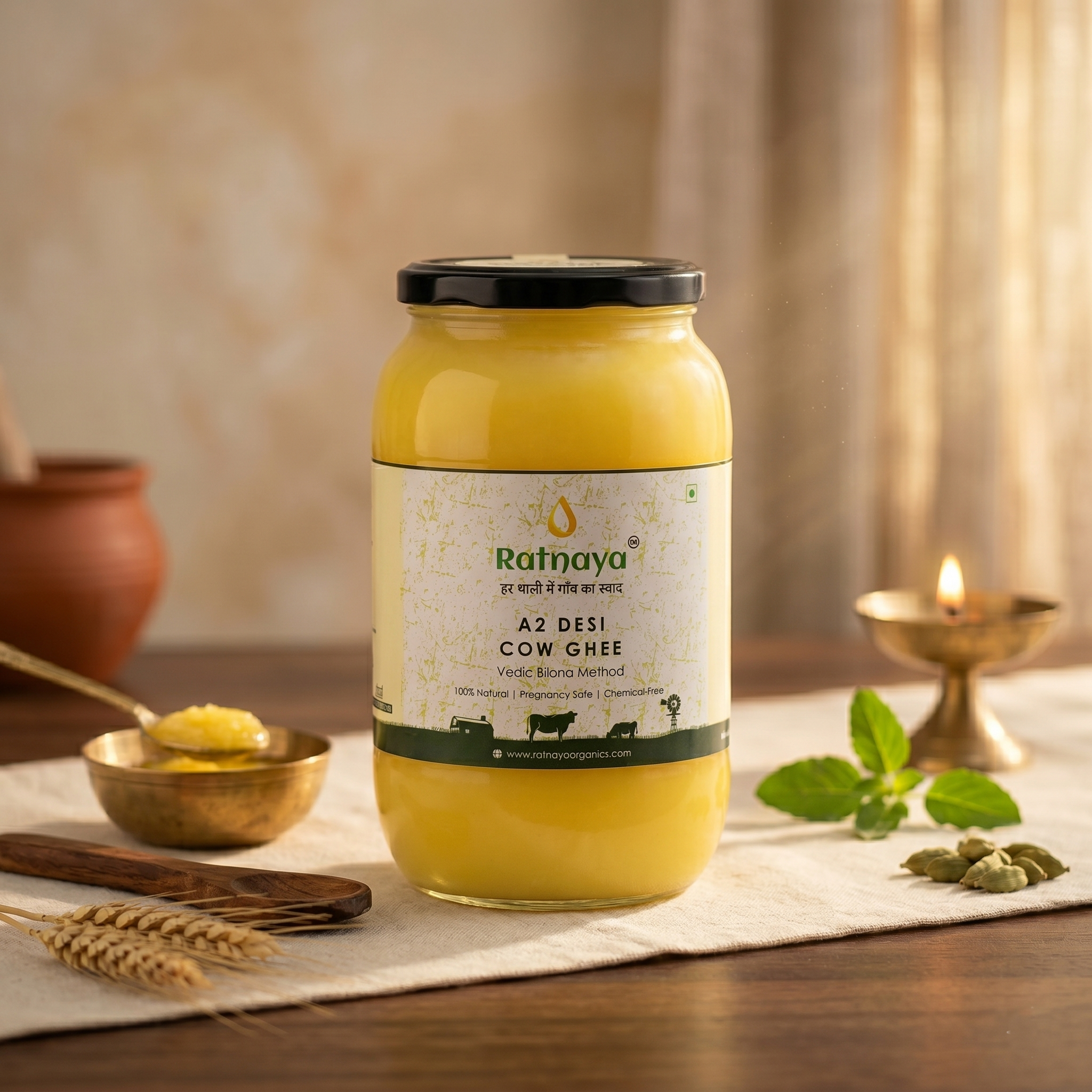
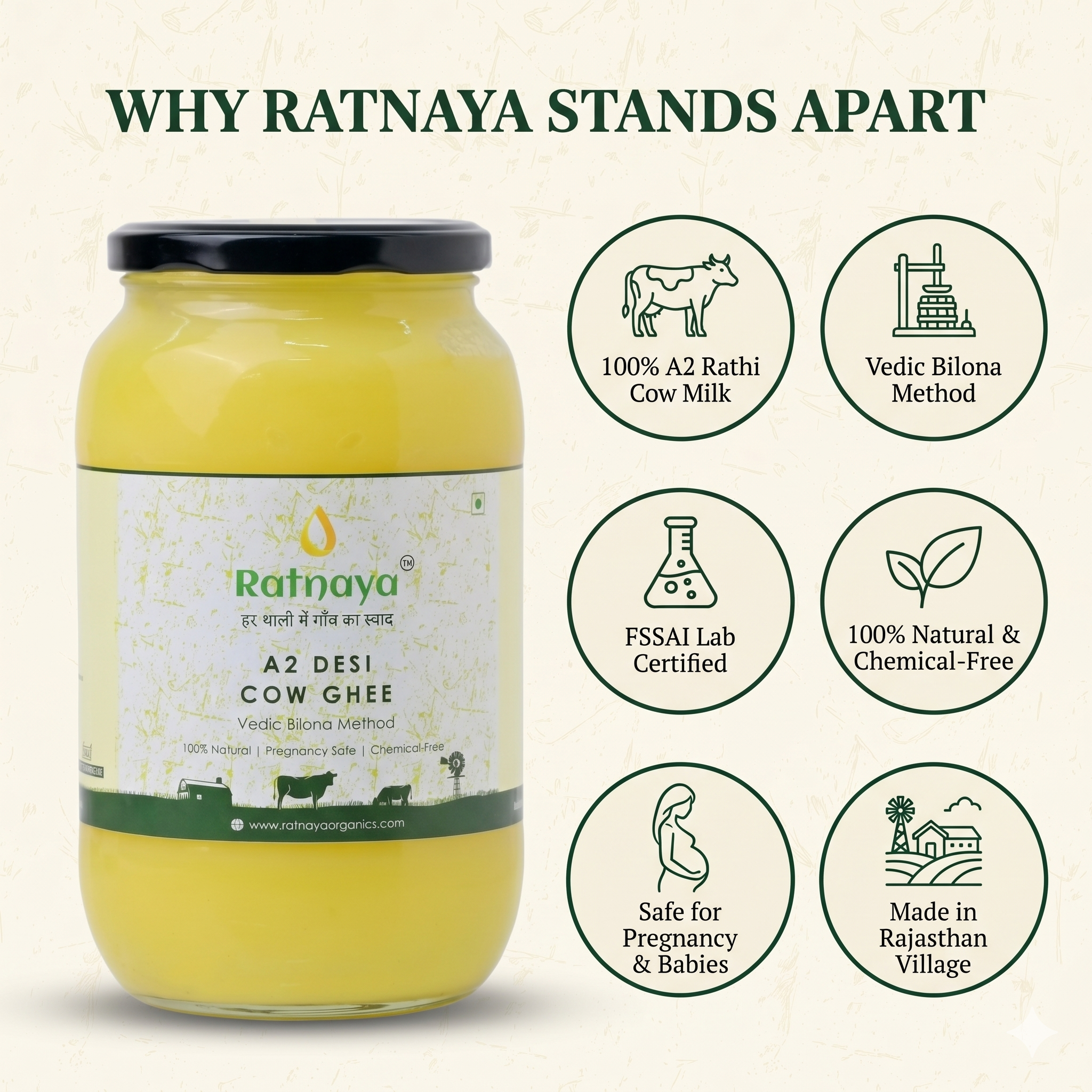
About our ghee: Ratnaya Organics makes A2 Rathi cow bilona ghee on a 110-acre certified organic farm in Sri Ganganagar, Rajasthan — milk fermented into curd, hand-churned, slow-cooked over a wood fire, and lab-tested every batch. If you are switching from butter to ghee, start with the 250ml jar and taste the difference in one week of cooking.
Frequently Asked Questions
Is ghee healthier than butter?
For Indian-style cooking, generally yes — ghee has a far higher smoke point, so it stays stable at tadka and frying temperatures where butter burns, and it contains almost no lactose or casein. Calorie-wise they are similar, so quantity still matters: 1–2 teaspoons per meal is the sensible measure.
Can lactose-intolerant people eat ghee?
Most can, comfortably. The clarification process removes almost all lactose and casein from ghee. People with severe milk allergies should still start with a small quantity and consult their doctor.
Can I make ghee from butter at home?
Yes — simmer unsalted butter on low heat for 15–20 minutes until the milk solids settle and brown at the bottom, then strain. But note: butter-made ghee is not bilona ghee. Traditional bilona ghee starts from curd, not cream, which is what preserves butyric acid and gives the grainy texture.
Which is better for weight management — ghee or butter?
Both are calorie-dense fats, so neither is a weight-loss food by itself. Ghee's CLA content and satiety value make it the traditional choice in moderation — the honest answer is that quantity and overall diet matter far more than the ghee-vs-butter choice.
Why does restaurant food taste different from ghee-cooked home food?
Most restaurants cook in refined oil or vanaspati for cost reasons and add a spoon of ghee only on top for aroma. Food actually cooked in pure ghee — the way it's done at home — has the flavour through the dish, not just on the surface.