
India's organic food market crossed ₹1.2 lakh crore in FY 2025, and A2 bilona Ghee is its fastest-growing segment - projected at 22.3% CAGR through 2033. Yet 7 out of 10 consumers who search "buy A2 ghee online" don't know what bilona churned ghee actually means - or that the method changes everything about what's inside the jar. This guide fixes that.

Walk into any kirana store or click through Amazon, and you'll find dozens of ghee jars - all claiming to be "pure," "desi," "A2," even "bilona." The prices range from ₹350 to ₹2,500 per kilogram. The labels look different. The claims sound similar. The question is: what are you actually buying?
The answer depends almost entirely on one thing: whether your ghee was made by the bilona method or not. Not the cow breed. Not the label design. Not the Instagram marketing. The process is what determines whether your ghee is a nutritional powerhouse or just an expensive cooking fat.
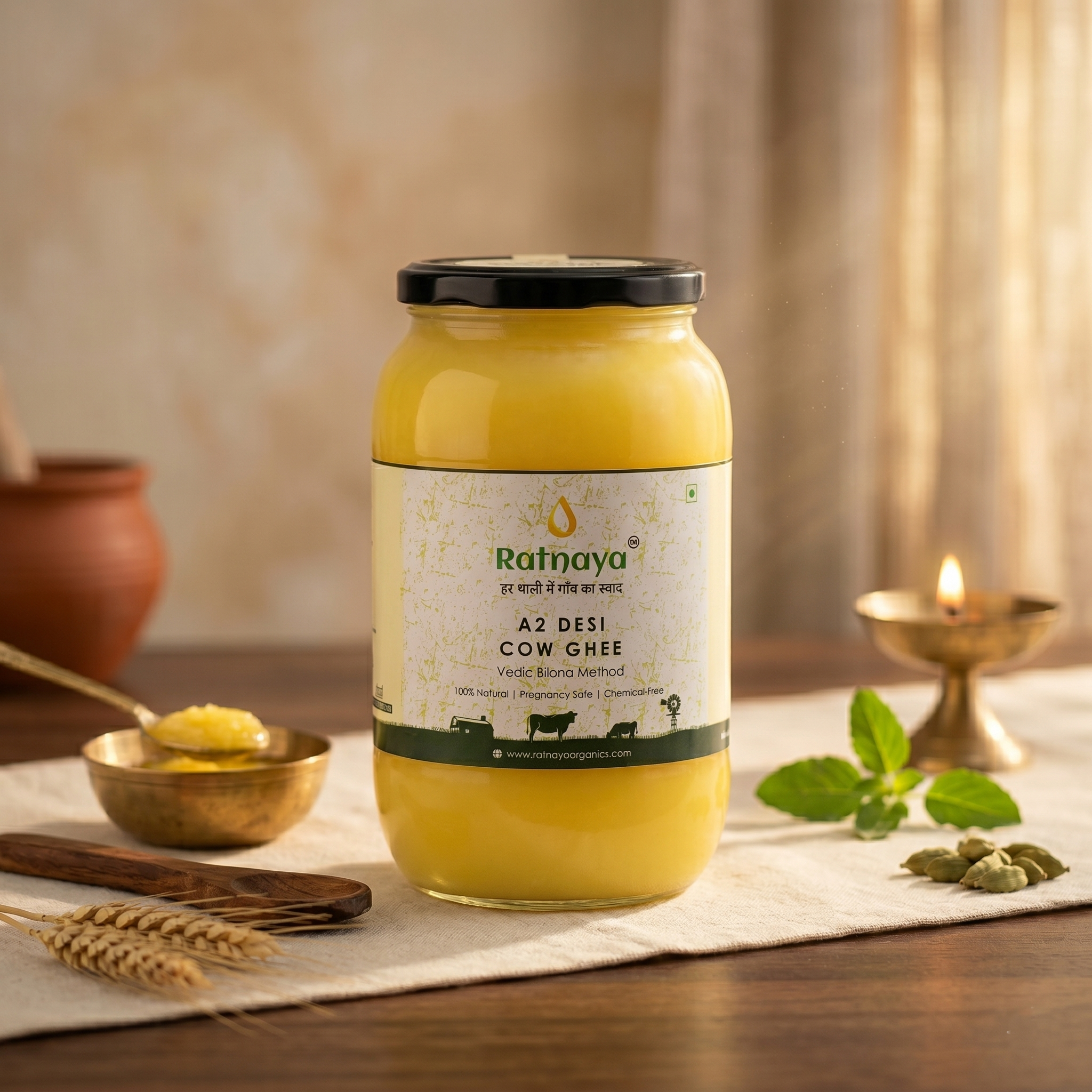
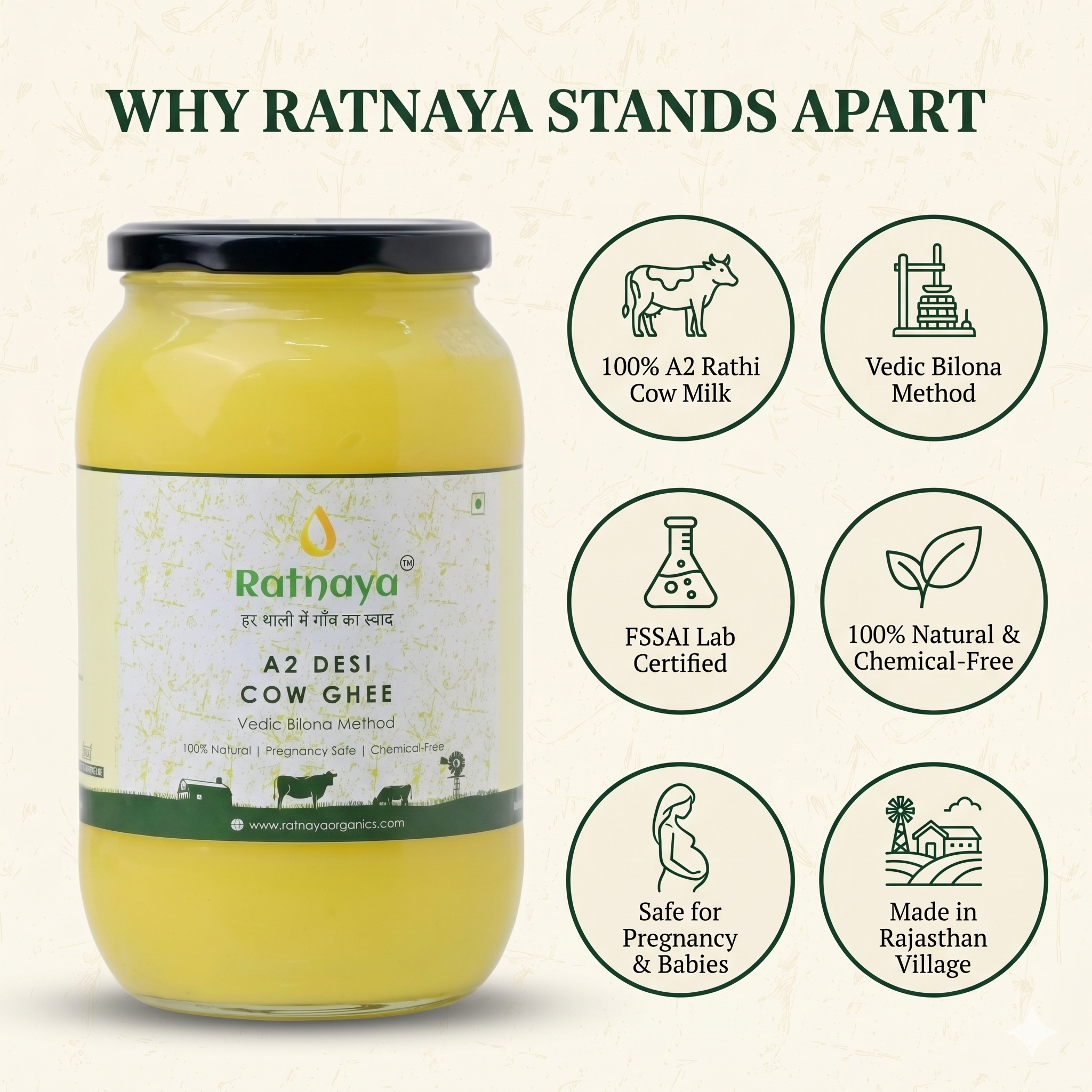
We've been making bilona ghee on 110 certified organic acres in Sri Ganganagar, Rajasthan, since 2019. We use Rathi cows - Rajasthan's indigenous breed, more A2-concentrated than most. We've sold to 6,360+ families across India. We've made every mistake, learned every shortcut other brands take, and refused to take them. This is our honest guide.
"In the Charaka Samhita, ghee prepared from cultured butter - not cream - is described as having superior qualities for promoting Ojas, intellect, and digestive fire. The process of bilona is not traditional for tradition's sake. It is science."
-Charaka Samhita, Sutrasthana · Validated in PMC10789628, Journal of Ayurveda & Integrative Medicine (2024)
What Is the Bilona Method - And Why Does It Change Everything?
The word bilona refers to the traditional wooden churner used across Rajasthan and Gujarat for thousands of years to separate butter from curd. Today, it describes the entire process of making ghee from curd, not cream. Here's why that distinction is critical:1
1) Fresh A2 Cow Milk - Collected Same Day
Pure, fresh milk from Rathi cows is collected at 5–6 AM directly from the farm. No preservatives. No mixing of buffalo milk (a common adulterant). At Ratnaya, our partner Prem Singh hand-milks 30+ Rathi cows daily - each producing 6–8 litres of rich A2 milk.
2) Overnight Curd Formation (Fermentation)
The milk is gently warmed, a small amount of natural curd culture (jaman) is added, and it's left to set overnight - usually 8–10 hours. This fermentation step is completely skipped in commercial ghee production. It is also where the magic begins: fermentation increases bioavailability of nutrients and reduces lactose significantly.
3) Hand-Churning - The Bilona Step
The next morning, the curd is placed in a clay or wooden vessel and churned by hand with a wooden bilona (churner). Slow, rhythmic, bidirectional churning separates the white butter (makkhan) from buttermilk (chaas). This step takes 30–45 minutes per batch. No machine can replicate the temperature control and gentle agitation that preserves fat microstructure.
4) Slow Heating - Clarifying the Butter
The makkhan is then slow-heated over a low flame - never high heat - until all moisture evaporates and the milk solids settle. Pure, aromatic ghee is what remains. Total time from fresh milk to sealed jar: 18–24 hours. Minimum. You cannot rush Bilona.
5) Straining, Cooling & Sealing
The hot ghee is strained through a clean muslin cloth to remove any solids, poured into glass jars while liquid, and sealed. As it cools, authentic bilona ghee often develops a granular or grainy crystalline texture - a quality marker, not a defect. It means the fat crystallised naturally without homogenisation.
Bilona Method vs Cream/Commercial Method - Side by Side
|
Process Factor |
🏆 Traditional Bilona Ghee |
Commercial Cream-Based Ghee |
Supermarket "Desi Ghee" |
|
Starting Material |
Full A2 cow milk |
Machine-separated cream |
Mixed cream/blend |
|
Fermentation Step |
✅ Yes - overnight curd |
❌ No - skipped entirely |
❌ No |
|
Churning |
Hand-churned (bilona) |
Machine centrifuge |
Machine |
|
Heat Method |
Slow, low flame |
High-speed industrial |
Industrial |
|
Butyric Acid Preserved |
✅ HIGH |
❌ MINIMAL |
❌ VERY LOW |
|
CLA (fat metabolism) |
✅ Rich |
Low |
Negligible |
|
Vitamins A, D, E, and K |
✅ Intact |
Partially lost |
Mostly lost |
|
Omega-3 Fatty Acids |
✅ Preserved |
Degraded by heat |
Negligible |
|
Lactose Content |
Near-zero (fermented out) |
Very low |
Very low |
|
Texture (when cool) |
Granular/grainy ← authentic |
Smooth, uniform |
Smooth, uniform |
|
Production Time |
18–24 hours per batch |
2–4 hours (industrial) |
Industrial scale |
|
Yield from Milk |
25–30 litres = 1 kg ghee |
15–18 litres = 1 kg |
12–16 litres = 1 kg |

⚠️ The ₹600 Bilona Ghee Trap
Pure A2 Rathi cow milk from ethical farms costs ₹80–100/litre. Producing 1 kg bilona ghee needs 25–30 litres - that's ₹2,000–3,000 in raw milk alone, before labour, packaging, or delivery. Any brand selling "A2 bilona ghee" under ₹900/kg is making a mathematical impossibility. They're either using A1 cow milk, the cream method, or both.
Bilona Ghee Price in India 2026 - What You Should Actually Pay
The most searched query in this niche is "bilona ghee price 1kg" - and the range you'll find online is ₹599 to ₹2,800. That spread is not a market anomaly. It's a fraud indicator. Here's what the real price reflects:
Price Range Reality Check - What Each Tier Tells You

Mind Map - The Complete Bilona Ghee Universe

9 Proven Benefits of A2 Bilona Ghee - From Gut to Skin
These are not influencer claims. They are backed by the 2024 systematic review in the Journal of Ayurveda & Integrative Medicine (PMC10789628), the Charaka Samhita, and 7 years of direct customer feedback from 6,360+ families across India.
1) Ignites Digestive Fire (Agni)
Butyric acid directly feeds gut-lining cells (colonocytes), stimulates digestive enzyme production, and repairs intestinal permeability. Ghee that won't cause stomach issues - this is the reason why: bilona ghee's butyric acid content is 3–4x higher than cream-method ghee.
2) Immunity Boost for Kids & Adults
Vitamins A, D, E, and K in bilona ghee are fat-soluble - meaning they need dietary fat to be absorbed. Ghee provides both the vitamins AND the transport mechanism. For A2 ghee for kids' immunity: ½–1 tsp daily in dal or roti is the most effective delivery mechanism Ayurveda knows.
3) Brain Development in Children
DHA omega-3 from grass-fed A2 bilona ghee is a primary building block of brain tissue and myelin sheaths. Ayurveda calls ghee a medhya rasayana - a brain tonic. For children under 10, this translates to measurable improvements in focus, memory, and learning capacity when consumed daily.
4) Weight Loss - Not Weight Gain
CLA (conjugated linoleic acid) found richly in bilona ghee from grass-fed A2 cows has been shown in multiple studies to inhibit fat storage enzymes and boost metabolic rate. MCTs convert to energy directly. A2 ghee for weight loss works best when replacing refined cooking oils - not added on top.
5) Glowing Skin & Strong Hair
Cow ghee for hair and skin is one of Ayurveda's oldest prescriptions. Fat-soluble vitamins hydrate skin from the cellular level - reducing dryness, pigmentation, and early ageing. For hair, the omega fatty acids strengthen follicles and reduce breakage. Customers report visible results within 3–4 weeks.
6) Joint Health & Bone Density
Vitamin K2 in A2 bilona ghee activates osteocalcin - the protein that locks calcium into bones. Ghee also naturally lubricates synovial fluid in joints, reducing morning stiffness. Especially vital for seniors, athletes, and anyone with arthritis or joint discomfort.
7) Safe for Lactose Intolerance
The bilona process ferments out nearly all lactose in the curd stage. Slow clarification removes remaining proteins. What's left is essentially pure butterfat - with near-zero lactose. A2 ghee for lactose-intolerant people: start with ¼ tsp, increase over 7 days. Most tolerate it completely.
8) Daily Gentle Detox
Ghee's lipid-soluble nature allows it to bind to fat-soluble toxins and carry them through the digestive tract for elimination. It enhances bile production - supporting your liver, the body's actual detox organ. Unlike harsh cleanses, this works gradually without energy depletion.
9) Heart Health - The Counterintuitive Truth
The saturated fat in A2 bilona ghee is primarily short and medium-chain, both associated with raising HDL (good cholesterol) without negatively impacting LDL. Multiple Ayurvedic practitioners and functional medicine doctors now recommend bilona ghee over refined vegetable oils for cardiovascular health.
How to Check If Your Bilona Ghee Is Real or Fake - 7 Tests
With "adulteration in ghee how to check" being one of the top-searched ghee queries in India, this section might be the most practically useful thing in this article:
✅ Signs of REAL Bilona Ghee
-
Granular/grainy texture when cool (below 25°C) - this is crystallised fat from the slow bilona process. It is not a defect.
-
Deep golden or amber colour - rich in beta-carotene from grass-fed A2 cows
-
Rich, nutty, caramelised aroma - from the slow Maillard reaction during heating
-
Melts unevenly in your palm - bilona fat crystals melt at different temperatures
-
No oil separation when stored at room temperature
-
Lab certificate available for every batch on request
-
QR code or farm address on the label - you can verify the source
❌ Warning Signs of Adulterated Ghee
-
Perfectly smooth, uniform texture - machine-homogenised, not bilona-churned
-
Pale yellow or nearly white colour - low beta-carotene, likely A1 or crossbred cow
-
No smell or a waxy artificial scent - synthetic flavouring additives
-
Oily layer separates when heated - adulterated fat blend
-
Price under ₹900/kg - mathematically impossible for genuine bilona A2 ghee
-
"Why does my ghee smell bad?" - rancidity from poor storage or low-quality fats
-
No farm name, no lab report, no cow breed mentioned anywhere on the label
🧪 The Home Spoon Test
-
Place ½ tsp ghee on your palm. Rub gently. Pure bilona ghee melts within seconds from body heat - unevenly, leaving a faint golden residue.
-
Heat a spoon until hot, and add a small amount of ghee. Pure ghee melts instantly, clear and golden. Adulterated ghee crackles, turns whitish, or smells chemical.
-
Check texture from the fridge: real bilona ghee is grainy-solid. Fake ghee is smooth like butter.
A2 Bilona Ghee vs Regular Ghee - The Complete Comparison
|
Factor |
🏆 A2 Bilona Ghee (Ratnaya) |
Regular Ghee (Commercial) |
A2 Cream-Method Ghee |
|
Milk Protein |
Pure A2 beta-casein |
A1/A2 mix or A1 dominant |
A2 (but cream method) |
|
Cow Breed |
Rathi (indigenous Rajasthan) |
Crossbred / HF / Jersey |
Gir / Sahiwal (varies) |
|
Bilona Process |
✅ Yes |
❌ No |
❌ No |
|
Digestibility |
Highest |
Lower - A1 BCM-7 peptide |
Medium |
|
For Lactose Intolerant |
✅ Safe (near-zero lactose) |
May cause issues |
Usually safe |
|
For A2 ghee for kids |
✅ Ideal |
Not recommended |
Acceptable |
|
Butyric Acid |
Highest (bilona preserves) |
Lowest |
Low-medium |
|
A2 ghee 1kg price |
₹1,799 (transparent) |
₹400–700 |
₹1,200–2,000 |
|
Farm Traceability |
✅ QR to farmer |
❌ None |
Varies |
Why Rathi Cow Ghee Is Different from Gir Cow Ghee
The Rathi Cow - Rajasthan's Indigenous A2 Breed: The Gir cow (Gujarat) gets all the marketing attention in the A2 ghee world. But in the Thar desert of western Rajasthan, there's an indigenous breed that has been producing exceptional A2 milk for centuries: the Rathi cow. Biologically adapted to extreme desert conditions, the Rathi produces less milk per day (6–8 litres) - but at a higher nutritional concentration than high-yield crossbred cows. Less volume. Richer fat. More omega-3. More beta-carotene. Better ghee.
Our partner Prem Singh - Ratnaya's Farmer of the Year 2025 - manages 30+ Rathi cows with a 265-day lactation cycle, 5 AM daily milking, 100% organic fodder, and zero antibiotics or hormones. Every litre of A2 milk that goes into Ratnaya bilona ghee comes from this herd, from this village (Shoypura, Sri Ganganagar), on this certified organic farm.
How Much Bilona Ghee Per Day - By Age & Goal
The most common question: "How much ghee per day is healthy?" The answer varies by constitution (Prakriti) and goal. Here's the practical guide:
|
Person / Goal |
Daily Dosage |
Best Time |
Notes |
|
Infants (6–12 months) |
¼ tsp in food |
Lunch |
Add to khichdi or dal - never give directly |
|
Children (1–10 yrs) |
½–1 tsp |
Morning food/roti |
Best for brain, immunity & bone growth |
|
Teens (11–18 yrs) |
1–2 tsp |
Morning or meals |
Focus, energy, hormonal balance |
|
Adults (health maintenance) |
1–2 tsp |
Empty stomach + cooking |
Replace refined oils entirely |
|
Weight Loss Goal |
1 tsp empty stomach + 1 tsp cooking |
Morning + meals |
CLA effect best when replacing - not adding - oils |
|
Seniors (60+) |
1 tsp |
Morning or with meals |
Joint lubrication, memory, healthy fats |
|
Lactose Intolerant |
Start ¼ tsp, increase slowly |
Morning |
Pure bilona ghee near-zero lactose - most tolerate well |
|
A2 ghee vs regular ghee for babies |
¼ tsp in food, 8+ months |
Lunch |
A2 bilona preferred - no A1 BCM-7 peptide concerns |
🌾 Ready to Order Authentic A2 Bilona Ghee?
Farm-fresh, lab-tested, Rathi cow bilona ghee - delivered pan-India in 3–5 days. Scan the QR code to meet Prem Singh before you order.
🛒 250ml Trial - ₹549 🛒 500ml Jar - ₹949 🛒 1kg Jar - ₹1,799
From the Farm - Arvind Godara
Founder · Ratnaya Organics · Engineer-turned-Farmer · Sri Ganganagar, Rajasthan · Since 2019
I spent eight years as an engineer in Gurgaon and Chandigarh - working long hours, eating whatever was convenient, and slowly feeling the cost of that in my gut, my energy, and my skin. When I came back to Rajasthan in 2019, I didn't come back to the farm. I came back to figure out what was wrong.
What I found was simple: the food chain had broken somewhere between the cow and my plate. The ghee at the supermarket looked like ghee. It smelled a bit like ghee. But it wasn't made the way my grandmother's ghee was made - from curd, hand-churned, slow-heated, poured still warm into a clay pot. That ghee she made never gave anyone a stomach problem. It was the first thing she gave sick family members. It was in everything.
Seven years later, I manage 110 acres of certified organic land. Prem Singh milks his Rathi cows at 5 AM every morning. I still make bilona ghee in small batches - because you cannot make it any other way and call it honest. Every jar has a QR code. Scan it. See the farm. Know the cow. That is the promise that no big brand can make - and that no shortcut in production can back up.
If you've been consuming commercial ghee and wondering why your digestion is off, your energy is flat, or your skin is dull, you don't have a ghee problem. You have a process problem.
The bilona method is the solution that's been there for 5,000 years.