
TL;DR: Quick Verdict for Smart Buyers
The Reality: Nearly 15% of FSSAI-tested ghee samples contain adulterants. Online marketplaces, with their anonymity and scale, have become hunting grounds for fake ghee sellers mixing vanaspati, palm oil, and cheap vegetable oils into “pure desi cow ghee.”
Key Checks Before Buying: - FSSAI license verification (14-digit number visible on product page) - Seller transparency (farm location, production method, cow breed) - Price reality check (authentic pure desi ghee online cannot cost ₹800-1,000/kg) - Lab testing reports availability - Return/refund policy for quality issues
Realistic Pricing: ₹1,800-2,500/kg for authentic desi cow ghee online from verified sellers. Anything significantly cheaper likely contains adulterants.
Best Value: Direct-from-farm sellers with verifiable production, FSSAI licensing, complete transparency, and willingness to share testing reports or allow farm visits.
Who This Guide is For
If you’re researching pure desi ghee online options: Read the entire guide to understand adulteration methods, detection techniques, and seller verification.
If you’re ready to buy but worried about fake products: Skip to “Seller Verification Checklist” and “Customer Reviews Analysis Tips” sections.
If you’ve been burned by adulterated ghee before: Focus on “Common Adulterants” and “Home Testing Methods” to verify your next purchase.
If you’re confused by conflicting online claims: Read “Label Reading Skills” and understand what FSSAI regulations actually say vs. marketing hype.
Last month, a friend in Mumbai ordered what looked like premium “pure desi cow ghee” from a popular e-commerce platform. The product page showed golden ghee, claimed “100% pure,” displayed impressive reviews, and was priced at an attractive ₹1,200 per kg.
When the jar arrived, the ghee looked slightly off—too pale, almost waxy. She melted a spoonful in a pan. Instead of the rich, nutty aroma of authentic ghee, it smelled faintly of cheap cooking oil. A simple home test with iodine turned the sample purple—confirming starch adulteration.
She’d paid for desi cow ghee online. She received vanaspati mixed with cheap oils and starch.
This isn’t an isolated incident. The online ghee market in India has exploded in recent years, creating a perfect storm for adulteration. When you can’t see, smell, or taste the product before buying—when there’s no relationship, no accountability, just a product page and a checkout button—the opportunity for fraud multiplies.
The Adulteration Epidemic in Online Ghee Markets
According to the Food Safety and Standards Authority of India, approximately 15% of ghee samples tested across the country contain adulterants. But online marketplaces? The problem is significantly worse.
Why Online Platforms Are Vulnerable:
Anonymity at Scale: Sellers can list products from anywhere, often with minimal verification. A fake brand operating from a rented warehouse in one state can sell to customers across India with zero face-to-face accountability.
Race to the Bottom Pricing: E-commerce algorithms favor competitive pricing. When authentic desi cow ghee costs ₹1,800-2,500/kg to produce and sell, how do you compete with sellers offering “pure cow ghee” at ₹900/kg? You don’t—unless you’re adulterating.
Review Manipulation: Fake reviews, paid ratings, and selective deletion of negative feedback create an illusion of quality. A product with 4.5 stars and 500 reviews might have started with 200 legitimate 1-star complaints that mysteriously disappeared.
Seasonal Spikes: During festivals like Diwali, Navratri, and Dussehra, when ghee demand skyrockets, adulterated products flood online platforms. Sellers know customers are buying in bulk and may not test each batch immediately.
In 2025, government raids across Uttar Pradesh, Gujarat, and Rajasthan exposed large-scale operations where vanaspati, refined palm oil, and synthetic flavoring were being mixed with small amounts of real ghee, packaged in attractive jars with fake FSSAI numbers, and sold through major e-commerce platforms and regional online stores.
Common Adulterants: What They’re Really Selling You
When you search for “pure desi ghee online” or “desi cow ghee online,” here’s what fraudulent sellers are actually mixing into those jars:
1. Vanaspati (Hydrogenated Vegetable Fat)
What It Is: Partially hydrogenated vegetable oil, often made from palm oil. Solid at room temperature, cheap, and mimics ghee’s texture.
Why Sellers Use It: Vanaspati costs ₹150-250/kg. Mix 70% vanaspati with 30% real ghee, add synthetic milk flavoring, and you’ve created “desi cow ghee” that sells for ₹1,200/kg. The profit margin is enormous.
Health Impact: Vanaspati contains trans fats, which research published in the PMC database shows are linked to increased LDL cholesterol, cardiovascular disease, insulin resistance, and higher cancer risk. A study found trans fats raise bad cholesterol by 20-30% while lowering good cholesterol.
How to Detect: The hydrochloric acid test—mix ghee with equal parts concentrated HCl and a pinch of sugar, shake for one minute, wait five minutes. A crimson color indicates vanaspati presence.
2. Refined Palm Oil
What It Is: Cheap vegetable oil that looks similar to ghee when solidified and cooled.
Why Sellers Use It: Palm oil costs ₹120-180/kg. It’s colorless when refined, making it perfect for adulteration. The Food Safety and Standards Authority of India released specific detection methods for palm oil in ghee because it’s so prevalent.
Health Impact: While not as harmful as vanaspati, palm oil contains significantly different fatty acid profiles. Research shows adulterated ghee lacks the beneficial short-chain fatty acids (butyric acid) and conjugated linoleic acid (CLA) found in real milk fat.
How to Detect: The β-sitosterol test in accredited labs. β-sitosterol is a plant sterol present in palm oil but absent in pure milk fat. The FSSAI released specific detection methods using reversed-phase high-performance liquid chromatography to identify β-sitosterol as a marker compound. Its presence confirms vegetable oil adulteration.
3. Cheap Vegetable Oils (Soybean, Cottonseed, Groundnut)
What They Are: Liquid vegetable oils mixed into ghee to increase volume.
Why Sellers Use It: These oils cost ₹150-300/kg. Mix them with ghee, add a thickening agent, and the texture appears normal to unsuspecting buyers.
Health Impact: Adulteration with these oils dilutes ghee’s nutritional benefits. You’re paying pure cow ghee price but getting mostly vegetable oil with minimal milk fat.
How to Detect: The Furfural test (detects sesame oil) and Baudouin test (detects cottonseed oil). These are standard laboratory tests used by FSSAI-approved facilities. A comprehensive ghee testing guide explains advanced detection methods including gas chromatography and HPLC analysis.
4. Starch (Potato, Sweet Potato, Rice)
What It Is: Cheap filler added to increase volume and create a thicker consistency.
Why Sellers Use It: Starch costs ₹30-60/kg. A small amount mixed into adulterated ghee helps mask the watery texture created by cheap oils.
Health Impact: While starch itself isn’t harmful, its presence proves adulteration. You’re buying weight in starch instead of actual ghee.
How to Detect: The iodine test—add 2-3 drops of iodine tincture to melted ghee. A blue or purple color indicates starch presence.
5. Synthetic Flavors and Colors
What They Are: Chemical additives to mimic ghee’s golden color and nutty aroma.
Why Sellers Use Them: When you dilute real ghee with 60-70% vanaspati or vegetable oils, it loses its natural color and smell. Synthetic milk flavoring and yellow coloring agents restore the appearance and aroma.
Health Impact: Coal tar dyes and artificial flavoring agents are not meant for consumption. Long-term exposure can cause allergic reactions and digestive problems.
How to Detect: The sulfuric acid test—mix melted ghee with diluted sulfuric acid. A pink color indicates coal tar dyes.
Home Testing Methods: Your First Line of Defense
Before you even order, understand these tests. After your order arrives, use them immediately:
The Pan Test (Immediate Visual Check)
Heat one teaspoon of ghee in a steel pan on medium heat.
Pure desi cow ghee: Melts immediately, turns deep golden-brown, releases a rich nutty aroma.
Adulterated ghee: Takes time to melt, turns light yellow or remains pale, smells like cooking oil or has a synthetic chemical odor.
The Refrigeration Test
Place ghee in the refrigerator for 2-3 hours.
Pure desi cow ghee: Solidifies uniformly, develops a slightly grainy crystalline texture. When you take it out, it softens at room temperature within 15-20 minutes.
Adulterated ghee: Solidifies in layers (heavier adulterants settle at bottom), may have a waxy or hard texture that doesn’t soften easily, or remains semi-liquid even when cold.
The Palm Test
Rub a small amount of ghee between your palms.
Pure desi cow ghee: Melts quickly from body heat, absorbs into skin leaving no greasy residue, feels smooth.
Adulterated ghee: Doesn’t melt easily, leaves a greasy film that doesn’t absorb, may feel waxy or sticky.
The Iodine Test (Starch Detection)
Melt half a teaspoon of ghee, add 2-3 drops of iodine tincture (available at any pharmacy).
Pure ghee: No color change, or slight yellowish tint.
Adulterated ghee with starch: Turns blue or purple immediately.
The HCl Test (Vanaspati Detection)
Heat one tablespoon of ghee in a test tube. Add equal quantity of concentrated hydrochloric acid and a small pinch of sugar. Shake vigorously for one minute. Let it rest for five minutes.
Pure ghee: No significant color change in the lower acid layer.
Adulterated ghee with vanaspati: Lower layer turns crimson or bright red.
Safety Note: Use gloves and eye protection when handling concentrated HCl.
The Water Dissolving Test
Mix one teaspoon of melted ghee in a glass of warm water. Stir gently.
Pure ghee: Dissolves evenly without leaving visible residue or oil slick on top.
Adulterated ghee: May leave oil droplets floating, visible sediment at bottom, or cloudy water indicating impurities.
Label Reading Skills: Decoding the Truth
When you’re buying desi cow ghee online, the product page and label are your primary information sources. Here’s how to read them like a food safety expert:
FSSAI License Number
What to Look For: A 14-digit license number. The first two digits indicate license type (10 for manufacturers, 11 for storage/distributors, 12 for transporters, 13 for retailers/food sellers).
How to Verify: Visit the Food Safety and Standards Authority of India official website, go to the “Check FSSAI License/Registration” section, enter the 14-digit number. The system will show the business name, license validity, address, and license type.
Red Flags: - No FSSAI number visible on product page - Fake/invalid FSSAI numbers (verify every single one) - FSSAI number belongs to a different business than the seller name - License expired or suspended (check date validity) - License type doesn’t match claimed business (e.g., a “manufacturer” with only a retailer license)
Ingredient List
What Pure Ghee Should Say: “Cow Milk Fat” or “Clarified Butter from Cow Milk” or “Milk Fat (Cow).” That’s it. One ingredient.
Red Flags: - Any mention of “vegetable fat,” “palm oil,” “edible oils,” or “milk solids” - Phrases like “prepared from cream and oils” or “milk fat blend” - Vague terms like “natural fats” without specifying cow milk - Lists multiple ingredients when ghee should be single-ingredient - “Vanaspati free” claims (why mention it unless you’re hiding something?)
Nutritional Information
Pure desi cow ghee per 100g: - Total Fat: 99.5-99.8g - Saturated Fat: 60-65g - Cholesterol: 250-300mg - No carbohydrates, no protein, no sugar
Red Flags: - Total fat below 99% (indicates water, adulterants, or filler content) - Zero cholesterol (impossible in real milk fat—vanaspati and vegetable oils have zero cholesterol) - Presence of trans fats listed (indicates hydrogenated fat) - Carbohydrate content above 0g (starch or sugar adulterant)
Manufacturing and Batch Details
What You Need: - Manufacturing date (within 3-6 months for best quality) - Batch number (allows traceability if issues arise) - Best before date (typically 12-18 months from manufacturing) - Manufacturing unit address (not just seller address)
Red Flags: - No manufacturing date or batch number - “Seller” and “manufacturer” addresses are different with no explanation - Generic “manufactured by” without specific facility details - No physical address—just a website or phone number
Seller Verification Checklist: 12 Questions Before You Click “Buy”
Here’s your systematic verification process when evaluating desi cow ghee online sellers:
1. Does the Seller Show Their Farm or Production Facility?
Legitimate sellers show their cows, their farm location, and their production setup. Look for photos, videos, or virtual tours on their website or social media. If they’re hiding their production source, there’s a reason.
2. Can They Name the Cow Breed?
Authentic pure desi ghee online sellers will specify: Gir, Sahiwal, Rathi, Red Sindhi, or other indigenous breeds. Vague terms like “Indian cows” or “desi breed” without specifics are red flags.
3. Do They Explain Their Production Method?
Traditional bilona method? Direct cream method? Industrial centrifuge? Legitimate sellers educate customers about their process. Sellers who can’t or won’t explain how they make ghee are hiding something.
4. What’s Their Milk Yield Story?
Indigenous cows produce 6-12 liters per day. It takes 25-30 liters of milk to make 1 kg of ghee. If a seller claims to sell 500 kg of ghee monthly, they need at least 12,500-15,000 liters of monthly milk production. Ask them: How many cows do you have? What’s your daily milk yield? The math should add up.
5. Are Lab Testing Reports Available?
Request FSSAI-approved lab testing reports for recent batches. Reports should show: - Fat content (minimum 99.5%) - Absence of β-sitosterol (vegetable oil marker) - Butyro-refractometer reading (BR reading) - Reichert-Meissl value - Absence of starch, coal tar dyes
Sellers who refuse or make excuses are suspicious.
6. What’s Their Pricing Justification?
If they’re selling desi cow ghee online at ₹900-1,200/kg, ask them to break down their costs. Real producers will explain: indigenous cow maintenance (₹20,000-25,000 annually per cow), low milk yield, processing costs, labor, packaging. If their pricing doesn’t make economic sense, they’re likely cutting corners through adulteration.
7. Do They Allow Farm Visits?
Even if you can’t physically visit, the willingness to allow visits is telling. Sellers operating from rented warehouses mixing vanaspati won’t invite you to “see their farm.”
8. What’s Their Return Policy for Quality Issues?
Legitimate sellers stand behind their product. Look for: money-back guarantee if lab testing proves adulteration, return acceptance for quality concerns, replacement policy for damaged shipments.
9. How Responsive Are They to Pre-Purchase Questions?
Message or call them with detailed questions about cow breed, production method, testing reports, farm location. Responsive, transparent sellers who answer thoroughly are more trustworthy than those who give vague responses or ignore inquiries.
10. Do They Have Consistent Brand Presence?
Check their website, social media, Google Maps listing. Established sellers have: - Professional website with detailed farm/production information - Active social media showing daily farm operations - Google Maps verified location with reviews - Contact information (phone, email, physical address)
Fly-by-night operations have blank social media, generic websites, or only marketplace presence.
11. What Do Their Reviews Reveal?
Don’t just read star ratings. Read actual review text. Look for: - Specific feedback (aroma, texture, color, home test results) - Photos from customers showing the actual product - Negative reviews and how the seller responded - Patterns in complaints (multiple customers reporting same issue)
Watch for fake review patterns: all 5-stars posted on same dates, generic text (“great product,” “nice ghee”), no photos, sudden spikes after negative reviews.
12. Are They Certified Beyond FSSAI?
Additional certifications add credibility: - Organic certification (NPOP, India Organic, PGS-India) - ISO certification for quality management - NABL-accredited lab testing - Membership in dairy cooperatives or organic farming networks
While not mandatory, these certifications indicate a seller serious about quality and transparency.
Comparison Table: Pure vs Adulterated Ghee
|
Characteristic |
Pure Desi Cow Ghee |
Adulterated Ghee (Vanaspati/Oils) |
|
Melting Point |
Melts at 28-32°C (body temperature) |
Remains solid or melts at higher temperature (palm oil: 35-40°C) |
|
Color |
Deep golden-yellow |
Pale yellow, whitish, or artificially bright yellow |
|
Texture |
Grainy crystalline when cold |
Smooth/waxy when cold, or layered appearance |
|
Aroma |
Rich, nutty, caramelized milk |
Mild/neutral smell, synthetic milk odor, or cooking oil smell |
|
Iodine Test |
No color change |
Turns blue/purple (starch present) |
|
HCl Test |
No crimson color |
Crimson red in lower layer (vanaspati present) |
|
Refrigeration |
Uniform solidification, softens in 15-20 min at room temp |
Non-uniform solidification, remains hard, or stays semi-liquid |
|
Fat Content |
99.5-99.8% |
<99% (water, fillers, or adulterants) |
|
Cholesterol (per 100g) |
250-300mg |
Zero or very low (vegetable oils have no cholesterol) |
|
Trans Fats |
Zero |
Present (vanaspati contains 5-40% trans fats) |
|
Price Range (₹/kg) |
₹1,800-2,500 |
₹800-1,400 |
|
β-sitosterol |
Absent |
Present (vegetable oil marker) |
Safe Payment and Delivery Practices
Beyond product quality, protect yourself during the online purchase process:
Payment Methods
Safer Options: - Credit cards (better fraud protection than debit cards) - Cash on Delivery (pay only after inspecting the package) - Third-party payment gateways (PayPal, Paytm, PhonePe, GPay with buyer protection)
Riskier Options: - Direct bank transfers to seller accounts (no recourse if product is fake) - Cryptocurrency (untraceable, no refunds) - Prepaid wallet transfers to unknown sellers
At Delivery
1. Inspect the package before paying (for COD):
– Check if package is sealed properly
– Verify brand/seller name on package matches your order
– Look for tampering signs (torn seals, repacked jars)
2. For prepaid orders:
– Photograph package immediately upon receiving
– Open carefully and document the unboxing on video
– Keep all packaging materials for 7-10 days in case return is needed
3. Immediate Quality Check:
– Perform pan test or palm test within 24 hours
– If you suspect adulteration, preserve sample for lab testing
– Keep all order invoices, communication, and product images
Dealing with Adulterated Products
If you receive adulterated ghee:
1. Contact the seller immediately: Email or call within 24-48 hours with photo/video evidence
2. File a complaint with the platform: Use Amazon/Flipkart/other platform’s complaint mechanism
3. Leave detailed negative review: Include photos, home test results, and timeline
4. Report to FSSAI: File online complaint at Food Safety Connect portal on FSSAI website with:
– Product name, brand, batch number
– Seller details and FSSAI license number
– Photos of product and label
– Your home test results (photos)
5. Consumer Court if needed: For amounts above ₹2,000-3,000, consider consumer court complaint through National Consumer Helpline (toll-free 1915 or online at the consumer affairs portal)
Customer Reviews Analysis: Reading Between the Lines
Smart buyers don’t just count stars—they analyze reviews forensically:
Green Flags in Reviews
• Specific sensory details: “Deep golden color, slightly grainy texture when refrigerated, strong nutty aroma when heated”
• Home test results: “Did the palm test—melted immediately from body heat”
• Comparison with previous purchases: “Better than my last brand, less waxy”
• Batch information: “Ordered batch #GH20250115, manufacturing date fresh”
• Photos of actual product: Real customer photos showing color, texture, jar condition
• Balanced feedback: “Good ghee but packaging could be better” (shows authenticity)
Red Flags in Reviews
• Generic praise: “Good product, fast delivery”—no specific quality details
• Only 5-star or only 1-star: Extreme polarization often indicates manipulation
• Sudden rating spikes: 20 five-star reviews posted in one day
• All reviews from new accounts: Check reviewer profiles—fake accounts have few reviews
• Seller responses that deflect: “That’s not our product” or “You didn’t store correctly” without addressing the actual complaint
• Deleted negative reviews: Compare review count with actual displayed reviews
Review Analysis Technique
Step 1: Filter reviews by “Most Recent” and “Verified Purchase Only”
Step 2: Read 3-4 star reviews first (most honest, balanced feedback)
Step 3: Sort negative reviews by “Most Helpful”—see what multiple customers complain about
Step 4: Check seller responses to complaints—are they defensive or constructive?
Step 5: Look for review patterns: - Same complaint from 3+ different customers = legitimate issue - Generic phrases repeated across reviews = likely fake - Detailed reviews with photos = more trustworthy
The Price-Quality Reality Check
Let’s do the math on what authentic pure cow ghee price should be:
Production Cost Breakdown (per kg): - Milk cost (25-30 liters at ₹50-70/liter indigenous cow milk): ₹1,250-2,100 - Processing and labor: ₹150-200 - Packaging: ₹50-80 - Logistics and overheads: ₹100-150
Total Cost: ₹1,550-2,530/kg
Minimum Sustainable Retail Price: ₹1,800-2,800/kg with reasonable profit margins
When you see desi cow ghee online at ₹900-1,200/kg, the seller is: 1. Losing money on every sale (unlikely) 2. Using crossbred/Jersey cows (not indigenous desi cows) 3. Adulterating with cheaper fats
There’s no middle ground. The economics don’t allow for authentic indigenous cow ghee below ₹1,600/kg wholesale, ₹1,800/kg retail.
Your Consumer Rights When Buying Online
Under the Consumer Protection Act 2019 and Consumer Protection (E-commerce) Rules 2020:
Right to Information: Sellers must provide complete, accurate information about ingredients, manufacturing, batch details, and FSSAI license.
Right to Safety: You have legal protection against products harmful to health. Adulterated ghee qualifies as a safety violation.
Right to Redressal: File complaints through: - National Consumer Helpline: Toll-free 1915, available in 17 languages, online filing through government consumer affairs portal - Consumer Courts: District Consumer Forum (up to ₹1 lakh), State Consumer Commission (₹1 lakh to ₹10 lakh), National Consumer Commission (above ₹10 lakh) - E-commerce Platform Grievance Mechanism: Most platforms have built-in complaint systems
Time Limits: Consumer disputes should be resolved within 3 months (simple cases) or 5 months (cases requiring lab analysis)
Building Trust in the Digital Marketplace
The online ghee market isn’t going away. E-commerce is here to stay. The question is: how do we buy pure desi ghee online safely?
For Buyers:
Start Small: Order 250-500g first, not 2-3 kg. Test thoroughly. Build the relationship gradually.
Ask Questions: Sellers who take time to educate you about their cows, their process, their costs—they’re more likely to be authentic.
Pay for Quality: If authentic desi cow ghee costs ₹1,800-2,500/kg, budget for that. The ₹900/kg “deal” isn’t a deal—it’s adulterated.
Document Everything: Keep records of your orders, conversations with sellers, and product quality. If issues arise, documentation is your leverage.
Build Direct Relationships: Once you find a trustworthy seller, stick with them. Direct repeat business often comes with better pricing and personalized service.
For Our Farm:
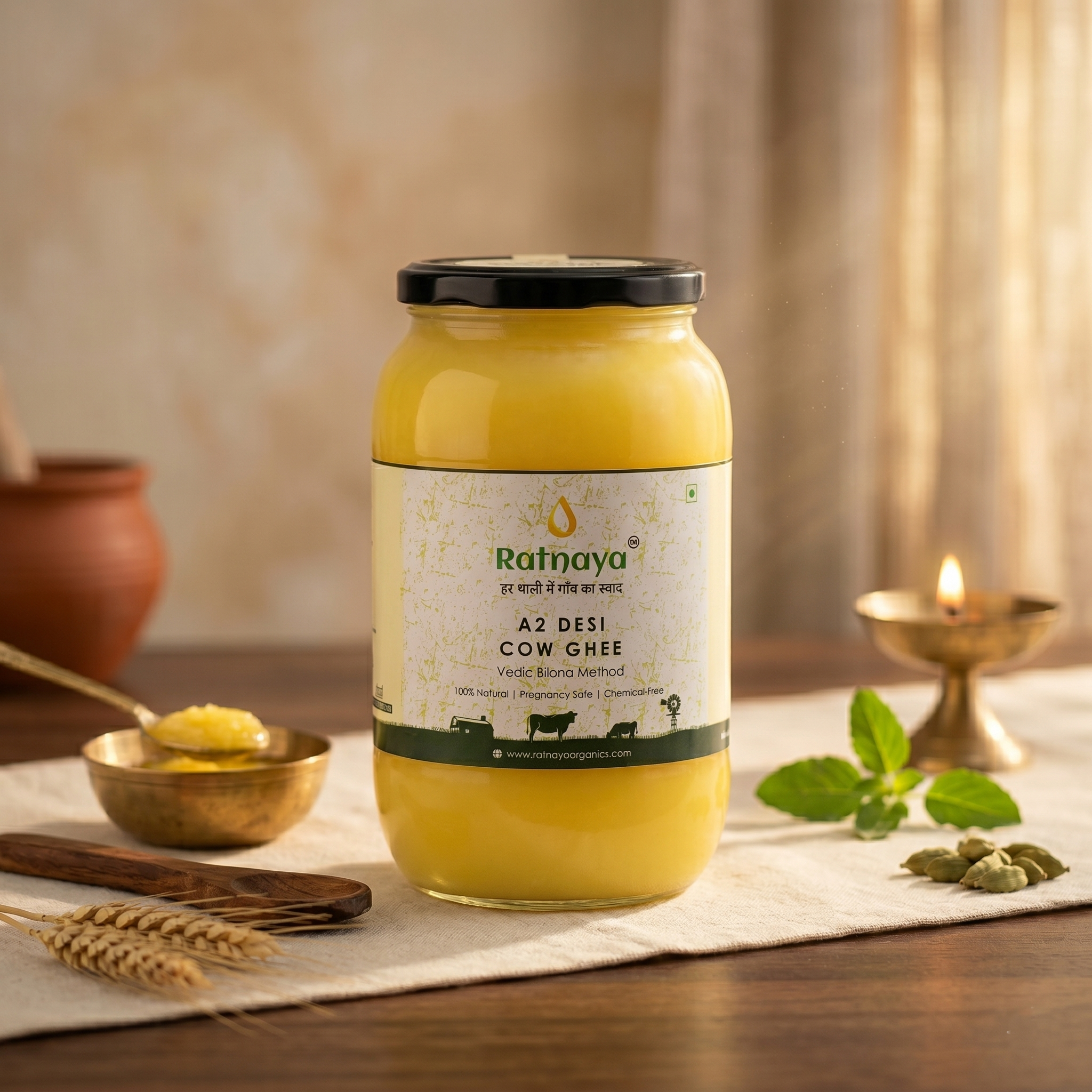
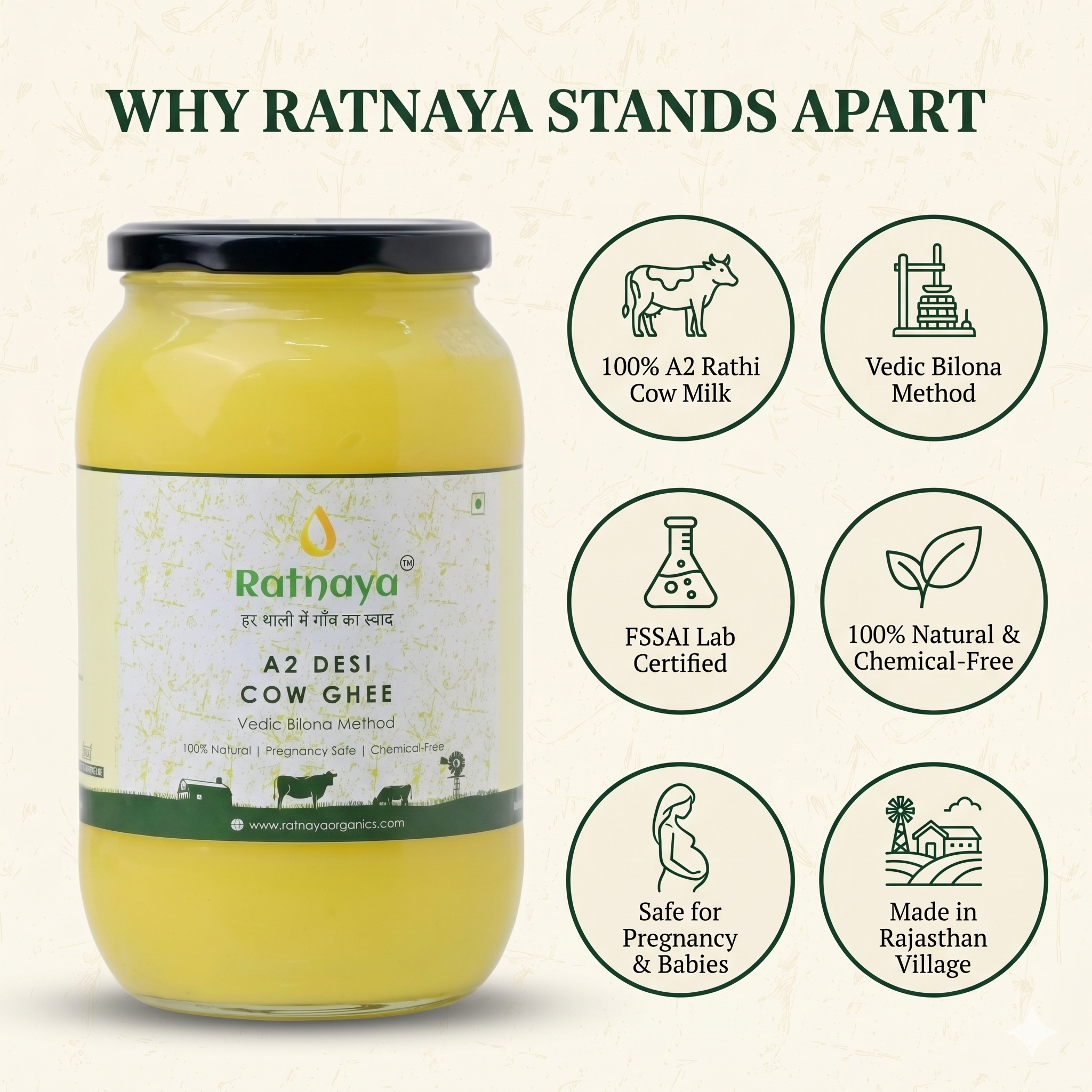
At Ratnaya Organics, transparency isn’t a marketing strategy—it’s survival. When customers can’t physically visit our Rajasthan farm to see our 40 Rathi cows, we bring the farm to them:
• Every batch includes QR code linking to farm videos
• Lab testing reports available on request
• WhatsApp number (9001924784) for direct questions
• Honest pricing: ₹2,000/kg reflects our real costs of indigenous cow maintenance and bilona method processing
• Clear communication about what we can and can’t promise
We know we can’t compete with ₹900/kg ghee sellers. We don’t try. We compete on trust, transparency, and the willingness to prove everything we claim.
The Final Home Test: When to Walk Away
You’ve ordered. The package arrived. You’ve done the pan test, the palm test, maybe even the iodine test. Now what?
Trust Your Instincts:
If it doesn’t smell right, doesn’t melt right, doesn’t look right—it probably isn’t right.
Don’t rationalize: “Maybe desi cow ghee is supposed to smell like this?” No. You know what pure ghee smells like—that rich, unmistakable nutty aroma. If you’re questioning it, something is wrong.
Document and return immediately: Take photos, perform and document home tests, contact the seller within 24-48 hours.
Your health is worth more than the hassle of a return.
FAQ: Pure Desi Ghee Online - Common Questions Answered
1. How can I verify an FSSAI license number when buying desi cow ghee online?
Visit the official Food Safety and Standards Authority of India website and navigate to their “Check FSSAI License/Registration” portal. Enter the 14-digit license number shown on the product page. The system will display the business name, address, license type, and validity dates. For pure desi ghee online purchases, verify that the license is current, belongs to the seller you’re ordering from, and matches the manufacturing/production facility listed on the product label.
2. What is the realistic price range for authentic desi cow ghee online?
Authentic pure desi ghee online from indigenous breeds typically costs ₹1,800-2,500 per kg. This pricing reflects the real production economics: 25-30 liters of indigenous cow milk (₹50-70 per liter) required per kg of ghee, plus processing, packaging, and logistics. Prices significantly below ₹1,600/kg indicate either crossbred cow milk, industrial processing methods, or adulteration with cheaper fats. Seasonal variations may add ₹100-200/kg during festival periods when demand is high.
3. What are the most common adulterants in desi cow ghee online products?
The five most common adulterants are: vanaspati (hydrogenated vegetable fat) costing ₹150-250/kg used to mimic texture; refined palm oil at ₹120-180/kg that looks similar when solidified; cheap vegetable oils like soybean or cottonseed at ₹150-300/kg to increase volume; starch (potato, rice, sweet potato) at ₹30-60/kg as filler; and synthetic flavors and colors to restore the appearance and aroma lost through dilution. A research study found that approximately 15% of FSSAI-tested ghee samples contain one or more of these adulterants.
4. Which home tests are most reliable for detecting adulteration?
The iodine test (detecting starch—blue or purple color indicates adulteration) and the hydrochloric acid test (detecting vanaspati—crimson color in the lower layer confirms hydrogenated fat presence) are the most reliable home tests. The pan test (observing melting behavior and aroma when heated) and refrigeration test (checking for uniform crystalline solidification and ease of softening) are good initial screens. However, for definitive verification, FSSAI-approved laboratory testing for β-sitosterol (vegetable oil marker), fat content, and fatty acid profile is recommended, especially for large or recurring purchases.
5. How do I file a complaint if I receive adulterated ghee?
File complaints through multiple channels simultaneously: First, contact the seller directly via email or the e-commerce platform’s complaint system within 24-48 hours with photo evidence and home test results. Second, report to FSSAI through their Food Safety Connect portal online, providing the FSSAI license number, batch details, photos, and test results. Third, file a complaint with the National Consumer Helpline (toll-free 1915) or through their online portal. For amounts above ₹10,000-20,000, consider filing in Consumer Court. Keep all documentation—order invoices, product photos, packaging, and correspondence with the seller.
6. What should I look for in customer reviews when buying pure desi ghee online?
Look for reviews with specific sensory details (color, aroma, texture descriptions), home test results shared by customers, and photos of the actual product showing color and crystalline texture. Balanced 3-4 star reviews are often most honest. Red flags include generic praise without details, sudden spikes of 5-star reviews on the same date, all reviews from new accounts, and patterns of deleted negative reviews. Read seller responses to complaints—defensive or dismissive responses indicate poor accountability. Sort by “Most Recent” and “Verified Purchase Only” to see current product quality.
7. Can I trust organic or A2 certification claims on desi cow ghee online products?
Verify all certification claims independently. For organic certification, check for NPOP (National Programme for Organic Production) or PGS-India certification numbers that you can verify on APEDA’s website. Note that organic certification verifies farming practices but doesn’t guarantee cow breed or production method. “A2” claims are trickier—the Food Safety and Standards Authority of India doesn’t officially recognize A2 labeling on fat products like ghee. Legitimate A2 claims require cow DNA testing (₹4,000 per cow) or milk protein analysis. Ask sellers for testing documentation. If they can’t provide verifiable certification numbers or testing reports, the claims are likely marketing rather than verified reality.
8. What’s the difference between buying desi cow ghee online vs from local markets?
Online purchases lack the sensory verification (smell, visual inspection, taste) available in local markets but offer wider selection, direct-farm access, and detailed product information. Online platforms require stronger due diligence—FSSAI license verification, lab report requests, and home testing upon delivery. Local markets allow immediate sensory checks but may have limited traceability and accountability. The trade-off: online buying offers convenience and potentially better farm-direct pricing for verified sellers, while local markets provide immediate quality assessment. For first-time buyers, start with small online orders (250-500g) to test quality before committing to bulk purchases. Build relationships with verified online sellers the same way you would with trusted local vendors.
Ready to buy pure desi ghee online safely?
Start with our verified farm-direct ghee from indigenous Rathi cows. Visit ratnayaorganics.com or reach us on WhatsApp: +91-9001924784. Every batch comes with complete transparency, lab testing reports on request, and our commitment to honest pricing that reflects real production costs.
Follow us on Instagram @ratnaya_organics for daily farm updates, production process videos, and genuine customer testimonials—no filters, no fake reviews, just real ghee from real cows.
Related reading: we have since published a fuller breakdown of which ghee purity tests actually work and which do not, including the one home test FSSAI endorses and our own NABL-accredited lab report in full — How to Check Ghee Purity: What Actually Works and What Doesn't.