
Key points
- Rathi is Rajasthan's own indigenous A2 cattle breed, native to Bikaner, Sri Ganganagar and Hanumangarh — not Gujarat's Gir.
- A Rathi cow gives 6–8 litres a day, roughly a third of a crossbred. That low yield is the main reason the ghee costs what it does.
- It takes roughly 30 litres of milk to make 1 litre of bilona ghee.
- Ghee is almost pure milk fat, so the A1/A2 casein debate matters far more for milk than for ghee. What actually differs is fat composition, fodder and method.
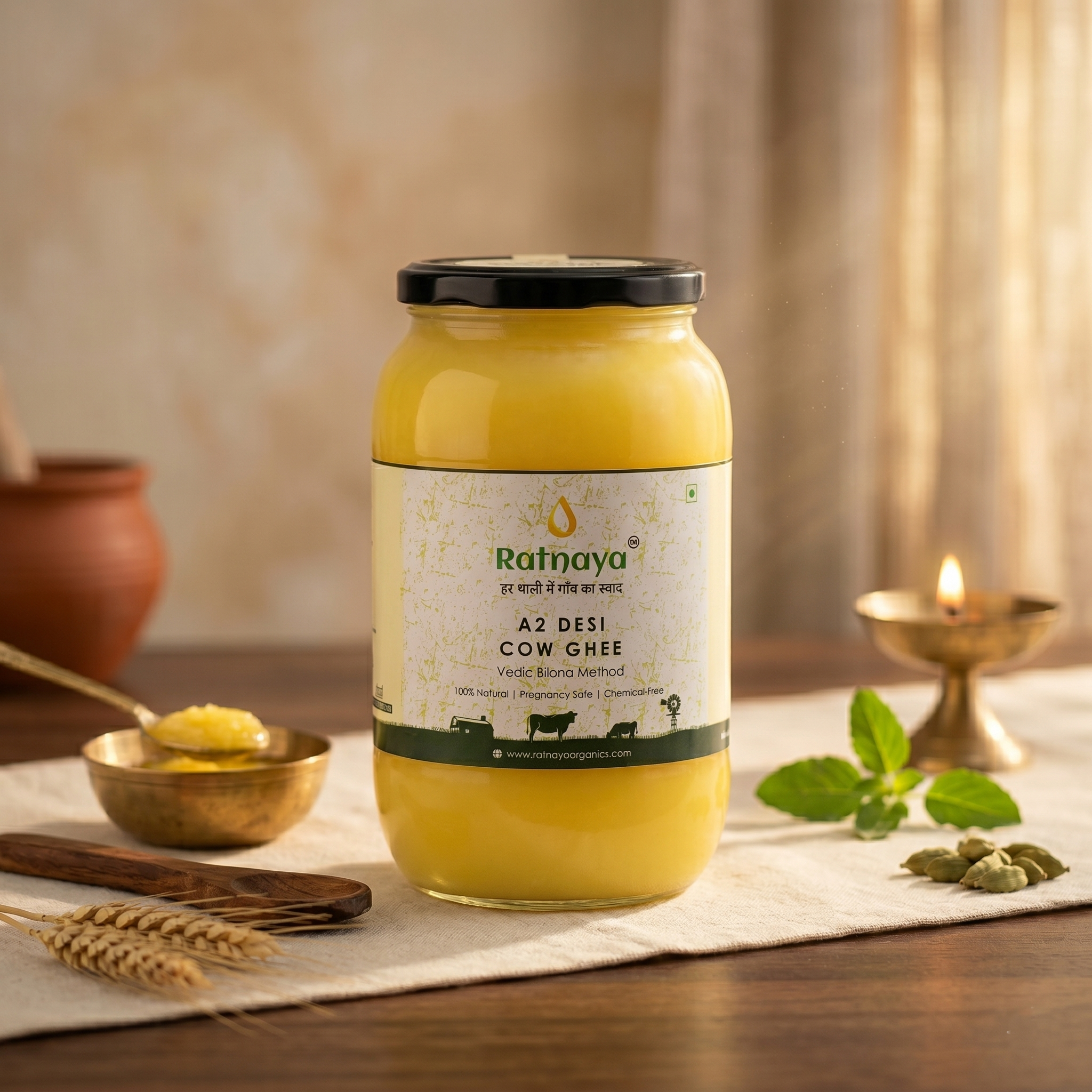
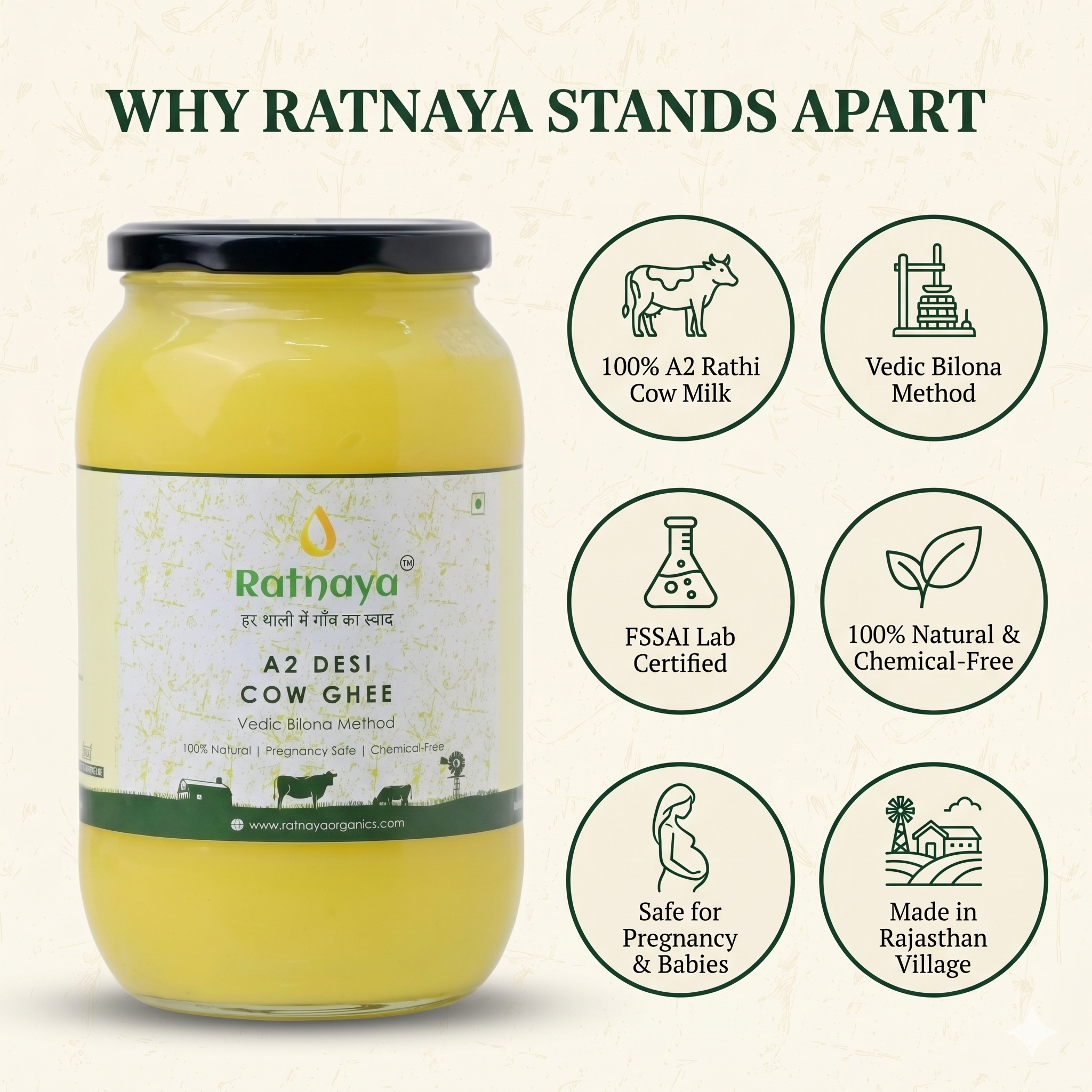
- Our Rathi bilona ghee is made in Sri Ganganagar and priced at ₹549 (250 ml) to ₹7,950 (5 litre).
Most A2 ghee sold in India comes from Gir cows. Search for “A2 ghee” and you will see Gir mentioned on almost every label. But Gir is a Gujarat breed, and Rajasthan has its own indigenous A2 cattle — the Rathi cow, sometimes called the Desert Queen or Rajasthan's Kamadhenu.
We make ghee from Rathi milk in Sri Ganganagar, which sits inside the breed's native tract. This guide covers what the Rathi breed actually is, whether its milk is genuinely A2, how the ghee compares to Gir and Sahiwal, what it should cost, and how to check that what you are buying is real. If you want the wider version of that last question first, our guide to buying organic cow ghee covers grass-fed claims and label traps in detail.
We have tried to keep this honest, including the parts that are less flattering. Where we are uncertain about something, we say so.
What Is the Rathi Cow Breed?
Rathi is an indigenous Indian cattle breed (Bos indicus) from the Thar Desert region of Rajasthan. It is one of the indigenous cattle breeds formally registered by the ICAR-National Bureau of Animal Genetic Resources (NBAGR), the government body responsible for identifying and registering India's animal genetic resources.
The breed takes its name from the Rath, a nomadic pastoral community that historically moved through the desert with their herds.
According to the Dairy Knowledge Portal maintained by NDDB, Rathi cattle are believed to have developed through intermixing of four breeds — Sahiwal, Red Sindhi, Tharparkar and Dhanni — with Sahiwal blood being dominant. This is why Rathi cows look somewhat like Sahiwal but carry the white patching that reminds people of Gir.
Physical characteristics
- Medium-sized frame, short or absent horns
- Straight face, flat forehead, wide-set eyes
- Usually brown with white patches across the body; some are fully brown or black with white patches
- Well-developed fore and hind quarters, long navel flap
What makes the breed remarkable is its hardiness. Its native region sees summer temperatures near 50°C, winters dropping to around 2°C, under 200 mm of annual rainfall, and regular dust storms. The Rathi cow produces milk consistently through all of it. Exotic breeds like Holstein or Jersey cannot survive these conditions without heavy intervention — cooling systems, imported feed, constant veterinary support.
Where Rathi Cows Actually Come From
This matters more than it might seem, because breed authenticity depends on geography.
The Rathi breeding tract covers Bikaner, Sri Ganganagar, Hanumangarh, Churu and Jaisalmer districts of Rajasthan. The highest concentration is in Lunkaransar tehsil of Bikaner district, an area known locally as the “Rathi tract.”
Our farm is in Sri Ganganagar, inside this tract. Our cows are not transported Rathi cattle kept in a different climate — they are living where the breed evolved, grazing on the fodder the breed adapted to.
Government conservation work on the breed
The Rathi breed has received sustained government attention, which is worth knowing because it tells you the breed is genuinely valued and not just a marketing story.
The National Dairy Development Board began a Rathi conservation and development programme in Bikaner and Sri Ganganagar districts in 2002. Under National Dairy Plan Phase-I, a pedigree selection project ran in the breed's native tract in partnership with URMUL Trust, covering villages in Lunkaransar and Chhatargarh tehsils of Bikaner. That work now continues under the Rashtriya Gokul Mission, the Department of Animal Husbandry and Dairying's national programme for indigenous breed development, launched in December 2014.
We should be clear that Ratnaya Organics is not part of any of these government programmes. We mention them because they establish that Rathi is a recognised, actively conserved breed — not because we have any affiliation with them.
How Much Milk Does a Rathi Cow Give?
Being honest about this is important, because it explains the price of the ghee.
Published figures vary by source and by whether cattle are on farms or in research stations:
| Source | Milk yield |
|---|---|
| NDDB / Dairy Knowledge Portal | 5–10 kg per day; lactation yield 1,500–3,000 kg |
| Krishi Jagran (breed profile) | Average lactation yield around 1,560 kg; range 1,062–2,810 kg |
| Livestock Research Station, Bikaner (research herd) | Standard lactation yield around 1,726 litres; peak yield around 9 litres/day |
| Our supplying herds, Sri Ganganagar | 6–8 litres per cow per day, over a lactation of about 265 days |
Compare this to a Holstein Friesian crossbred, which can give 20–25 litres a day.
A Rathi cow gives roughly a third of what an exotic crossbred gives. That is the honest trade-off. You are not buying more milk — you are buying different milk, from an animal that needs no artificial climate control and far less intervention to stay healthy.
Is Rathi Milk Really A2?
Here is where most ghee brands are vague, so we will be direct.
A1 and A2 refer to a variant of beta-casein protein in milk, not to the ghee itself. The difference comes down to a single amino acid at position 67 of the beta-casein chain. A1 milk produces a peptide called BCM-7 during digestion; A2 milk produces far less of it. Research on whether this meaningfully affects human health is ongoing and not settled — you can read the published literature on PubMed and form your own view. We have written a longer explainer on the difference between A1 and A2 ghee if you want the detail.
Indigenous Indian breeds, including Rathi, predominantly carry the A2 allele. European-origin breeds like Holstein Friesian carry a higher frequency of A1. This is the basis for calling Rathi an “A2 breed.”
But here is the part most brands leave out: breed is a strong indicator, not a guarantee for every individual animal. A2 status is determined by genotype, and within any indigenous herd there can be animals carrying an A1 allele, particularly where crossbreeding has occurred historically. The only way to be certain about a specific animal is genetic testing.
We have not genotyped our herd. Our cows are purebred Rathi from within the native tract, which makes A2 highly likely, but we will not claim a certainty we cannot prove with a test result. What we do test, every batch, is purity — the FSSAI fat-composition and adulteration panel described further down this page. If a brand tells you their ghee is “certified A2”, ask them whether the certificate is a herd genotype report or a purity report. The two are not the same thing, and the second is far more common than the first.
An important note on ghee specifically
Ghee is almost pure milk fat. Our own October 2025 batch tested at 99.82% milk fat. The beta-casein protein that A1/A2 refers to is largely removed during the ghee-making process, when milk solids are separated out.
This means the A1 versus A2 distinction is more meaningful for milk than for ghee. What genuinely differs between ghees is the breed's fat composition, what the animal ate, and how the ghee was made — not primarily the casein variant.
We say this even though “A2 ghee” is what people search for, because we would rather you buy from us understanding what you are actually paying for.
Rathi vs Gir vs Sahiwal: An Honest Comparison
| Rathi | Gir | Sahiwal | |
|---|---|---|---|
| Native region | Bikaner, Sri Ganganagar, Hanumangarh (Rajasthan) | Saurashtra, Gujarat | Punjab region, now also Rajasthan/Haryana |
| Registered by NBAGR | Yes | Yes | Yes |
| Typical lactation yield | 1,500–3,000 kg | 1,600–2,700 kg | 1,400–2,500 kg |
| Climate tolerance | Extreme — 2°C to 50°C, dust storms | High heat tolerance | High heat tolerance |
| Market availability of ghee | Limited — few brands | Widely available | Moderate |
| Typical price positioning | ₹1,949 per litre (our price) | Generally highest | Mid to high |
Which is “best”? Honestly, there is no strong evidence that one indigenous A2 breed produces nutritionally superior ghee to another. Differences in taste and aroma come more from what the cows eat, the season, and the ghee-making method than from breed alone.
What Rathi offers is regional authenticity and traceability. If you are in North India and want ghee from cattle native to your own region, fed on local fodder, Rathi makes sense. If someone tells you Rathi ghee is medically superior to Gir ghee, ask them for the study.
How We Make Rathi Ghee: The Bilona Method
The bilona method is the traditional process, and it is genuinely slower and more expensive than the industrial alternative. Our full explainer on why bilona-churned ghee is different goes deeper into the chemistry; here is what actually happens on our farm.
Our process, start to finish, takes about 18 hours from milking to a sealed jar:
- Morning and evening milking of Rathi cows in Sri Ganganagar
- Milk is boiled and cooled to set as curd
- Curd is set overnight using a culture starter
- Hand-churning (bilona) of the whole curd — not cream — using a wooden churner
- Makkhan (butter) is separated from the buttermilk
- Slow heating of the makkhan over a controlled flame until the water evaporates and milk solids separate
- Filtering while warm
- Filling into glass jars
Who actually does the churning
This is worth stating plainly, because it is unusual. We do not run a factory line. Milk is collected centrally in the village, and the women of the village set the curd and do the churning together, in small batches, by hand. Some of the milk comes from our own 110-acre organic farm; the rest we buy from Rathi-owning farmers in the same villages, at ₹50–55 per litre — roughly double what the village was getting before we started buying. You can meet some of them on our Know Your Farmer page, and every jar carries a QR code that takes you to the farmer behind it.
How this differs from the cheap method
Industrial ghee is usually made by separating cream from milk with a centrifuge and melting it directly. It skips the curd-setting and churning entirely. It is faster, cheaper, and yields more ghee per litre of milk. It is also legally ghee — it just isn't bilona.
The maths that explains the price
It takes roughly 30 litres of milk to produce 1 litre of bilona ghee. That figure is not borrowed from an industry brochure — it comes out of our own records. In 2025, one of our farmers, Prem Singh Ji, supplied about 63,600 litres of Rathi milk from a herd of 30-plus cows. That milk yielded a little over 2,000 litres of ghee. Divide one by the other and you get about 30 to 1.
At a Rathi cow's daily yield of 6–8 litres, that is close to a week of one cow's milk for a single litre of ghee.
Rathi Ghee Price: What You Should Expect to Pay
| Size | Our price | Price per litre |
|---|---|---|
| 250 ml glass jar | ₹549 (MRP ₹649) | ₹2,196 |
| 500 ml glass jar | ₹949 (MRP ₹1,199) | ₹1,898 |
| 1 litre glass jar | ₹1,949 (MRP ₹2,399) | ₹1,949 |
| 5 litre steel can | ₹7,950 (MRP ₹11,495) | ₹1,590 |
Free shipping on orders above ₹999. For the wider market picture — what other brands charge and why the range is so wide — see our breakdown of A2 ghee prices in India.
Why A2 bilona ghee costs several times more than supermarket ghee
- Milk volume: around 30 litres of milk per litre of ghee, versus far less for cream-separated ghee
- Low-yield cattle: a Rathi cow gives roughly a third of what a crossbred gives
- Labour: churning and slow-heating take hours per batch, done by hand
- Farmer price: we pay ₹50–55 a litre for village milk, well above the local rate
- No milk powder or blending: commercial ghee is sometimes made from reconstituted or blended sources
- Glass packaging: heavier and costlier to ship than plastic pouches
A caution about price: if you find “A2 bilona ghee” priced close to ordinary supermarket ghee, the arithmetic does not work. Either the milk is not from indigenous low-yield cattle, or the process is not bilona, or the product is blended. You are entitled to ask a seller which of these it is.
How to Verify You Are Buying Real Rathi Ghee
Five things you can check before paying:
1. Ask which breed and where the cattle are. A seller who cannot name the district their milk comes from is buying it on the open market. Rathi ghee should come from within or near the breeding tract. Ours comes from Suratgarh, Sri Ganganagar district.
2. Ask for a lab report — and read it. A genuine report from an FSSAI-recognised lab will show Reichert-Meissl value, Polenske value, Butyro-refractometer reading and moisture content, each against the limits set by the Food Safety and Standards Authority of India. A report that only says “Pass” tells you nothing. Here is what our most recent published batch returned, tested at Jagdamba Laboratories, Jaipur (a government-approved, ISO 9001:2015 test house), report no. JLFD250926039:
| Parameter | FSSR 2011 limit | Our result |
|---|---|---|
| Milk fat | Not less than 99.5% | 99.82% |
| Moisture | Not more than 0.5% | 0.17% |
| Butyro-refractometer reading at 40°C | 40.0–44.0 | 42.8 |
| Reichert-Meissl value | Not less than 24.0 | 28.54 |
| Polenske value | 0.5–2.0 | 1.36 |
| Free fatty acid (as oleic acid) | Not more than 2.0% | 0.275% |
| Iodine value | 25–38 | 33.79 |
| Saponification value | 205–235 | 217.77 |
| Baudouin test (detects vanaspati) | Negative | Negative |
| Mineral oil | Negative | Negative |
The two numbers worth understanding are Reichert-Meissl and Baudouin. RM value measures short-chain fatty acids that are hard to fake — a low RM value usually means the ghee has been cut with vegetable fat. The Baudouin test looks specifically for vanaspati. If a seller's report skips both, that is the report you should be asking about.
3. Check the FSSAI licence number on the label. You can verify any licence on the FoSCoS portal. No number, or a number that does not resolve, is a hard stop.
4. Look at the texture. Bilona ghee typically sets grainy in cooler weather rather than smooth and uniform. This is not a foolproof test — texture also varies with storage temperature — but uniformly smooth ghee in December is worth asking about.
5. Ask about batch dates. Small-batch producers can tell you when your specific jar was made. Large blenders usually cannot. Ours are printed on the jar and traceable to the churning batch.
For a fuller set of at-home tests you can run in your own kitchen, see our complete ghee testing and verification guide.
Our Herd and Our Farm
Ratnaya Organics started in 2019. The farm is 110-plus acres near Suratgarh in Sri Ganganagar district, Rajasthan, certified organic under Jaivik Bharat (India Organic). We are inside the Rathi breeding tract, not shipping cattle into it.
Some of our milk comes from our own herd; the rest is bought from Rathi-owning families in the surrounding villages. We name them rather than hiding them. Prem Singh Ji, our Farmer of the Year for 2025, is a third-generation dairy farmer with twenty years behind him and a herd of more than thirty Rathi cows. In 2025 he supplied about 63,600 litres of A2 milk across a 265-day lactation cycle, on entirely organic fodder.
Five years ago the village had no paved road. Today the ghee made there reaches more than 1,500 families across 190-plus cities. Milk that used to sell for ₹25–28 a litre now sells to us at ₹50–55.
If you would rather see it than read about it, you can. We host farm visits — message us on WhatsApp at +91 90019 24784 to arrange one. Every batch is lab-tested, and we will send you the full PDF report for the batch you received if you ask. The longer version of how this started is on our story page.
Frequently Asked Questions
Is Rathi cow ghee better than Gir cow ghee?
There is no strong evidence that one indigenous A2 breed produces nutritionally superior ghee to another. Both are registered indigenous breeds carrying predominantly A2 genetics. Rathi is native to Rajasthan and less commonly available; Gir is native to Gujarat and more widely sold. Choose on traceability and taste rather than on health claims.
How much Rathi ghee should I use per day?
Ghee is calorie-dense — roughly 900 kcal per 100 g. Most people use one to three teaspoons a day as part of normal cooking. If you have a specific health condition, cholesterol concern or are on a restricted diet, ask your doctor rather than following a general guideline from a ghee seller.
Does Rathi ghee contain lactose?
Ghee contains only trace amounts of lactose, as most milk solids are removed during preparation. Many people with lactose intolerance tolerate it. If you have a diagnosed dairy allergy, which is different from lactose intolerance, consult your doctor before trying it.
How should I store it?
In a cool, dry place away from direct sunlight. Refrigeration is not necessary and will make it hard to scoop. Always use a dry spoon — moisture is what spoils ghee.
How long does it keep?
Properly stored ghee keeps well beyond a year. Check the date printed on your jar.
Is Rathi ghee available outside Rajasthan?
Yes. We ship to every state in India and currently deliver to more than 190 cities. Shipping is free on orders above ₹999.
Where to Buy
We make Rathi bilona ghee on our own farm in Sri Ganganagar, in glass jars, in four sizes. If you have not tried it before, the 250 ml jar is the sensible place to start rather than committing to a litre.
Browse all sizes and current prices →
Local to Rajasthan? Our Rathi herd is kept inside the breed's own native tract, in Sri Ganganagar district. A2 bilona ghee in Rajasthan: why where it's made matters covers the farm, delivery across the state, farm visits, and what to check when buying ghee locally.